Queensborough Northern Red Oak
Description
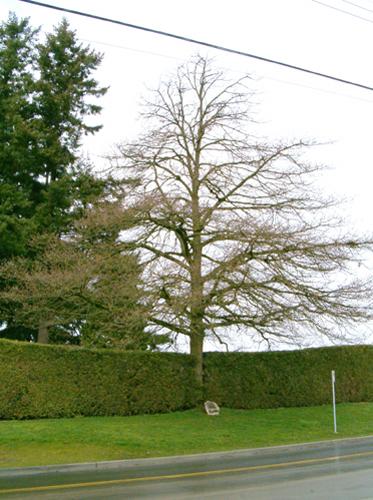
The Queensborough Northern Red Oak is an intact mature tree situated toward the northwest corner of the parcel addressed as 203 Pembina Street, in the Queensborough neighbourhood of New Westminster, B.C.
Valeur patrimoniale
Planted in or around 1968, and roughly six years old at the time of planting, the Queensborough Northern Red Oak tree is valued for its prominent corner location and as a natural landmark; it is furthermore valued as a tree that, over time, acquired cultural importance for its community association as a gathering place; and it is noteworthy for its age and relative rarity in the Queensborough neighbourhood of the city.
The Queensborough Northern Red Oak tree is significant for its prominent corner location at the junction of Pembina Street and Salter Street. It is situated at the front of the property addressed as 203 Pembina Street. Its canopy dominates both the frontage and views from all directions. As a natural feature, it is a physical landmark in the area.
The Queensborough Northern Red Oak tree is significant for the intangible value of its role as a community gathering place and it exemplifies the importance of community connections. Planted by the original long-term Italian-Canadian owners, Gino and Patricia Claret, and carefully maintained over many decades, it is valued for its importance to others in the community as an informal gathering place. In particular, it reflected the diversity of the community brought about by the post-war immigration and development that filled out the community. In addition, it brought together those who were stationed at the nearby local firehall: they would regularly bring their chairs and gather under the tree to take advantage of its generous shade. This regularly occurred until closure of the firehall around 1993.
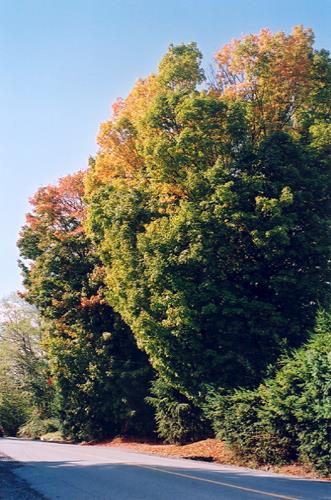
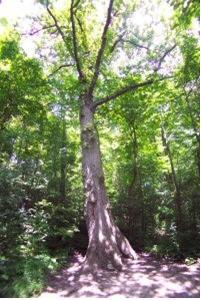
Additionally, the Queensborough Northern Red Oak tree is additionally valued for its relative rarity and qualities of its species, situated in a neighbourhood which has a small number of dominant-sized trees and which has no other trees of this age or prominence in the immediate area, either along Pembina Street or Salter Street. The Northern Red Oak is not native to British Columbia: it is native to eastern and central US and southcentral Canada, the Garry Oak is the only oak native to BC. While it may be found elsewhere in New Westminster, and recognized, there is no other known Northern Red oak tree within Queensborough and none that is formally recognized. Furthermore, its qualities extend to the longevity of the genus and species, amongst the longest living trees and one of the oldest tree genera on the planet. Its positive environmental impact vis a vis carbon sequestration and pollutant capture, and stormwater management (due to its size, longevity and water needs) is notable: oak can be among the greatest contributors to the environment. Its urban tolerance in terms of drought and disease resistance is high, and its distinguished bark (dark and light alternating stripes sometimes referred to as "ski slopes"), its vibrant red leaf colour in fall, and acorns that are non-invasive and enjoyed by wildlife, are all characteristics that result in a positive environmental and aesthetic contribution.
Éléments caractéristiques
The elements that define the heritage character of the Queensborough Northern Red Oak tree are its:
• end-of-block location with its contribution to spatial organization, as set on a flat parcel prominently situated at the northeast corner of Pembina Street and Salter Street, and situated close to the west property line;
• contribution to land patterns, and visual relationship as a local natural landmark with a strikingly wide and tall form, and its provision of shade in the summer;
• longevity at this location, in place since 1968;
• the use of the tree as a community gathering place;
• growth habit in its mature form, as a large spreading shade tree with deciduous leaves that provide shade in summer while allowing light to pass through in winter;
• in leaf from spring to late fall and bloom periods from mid-spring to late spring;
• dark reddish grey-brown colour of the bark; and
• scaly bark with broad, thin, rounded edges and texture of ridges.
Location
Loading map...
Lieux similaires
Sites patrimoniaux avec des caractéristiques semblables