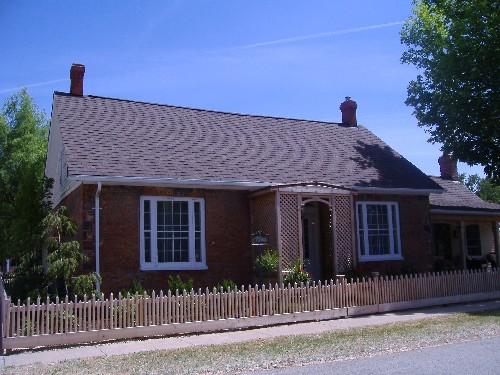
Photo: Photograph by Callie Hemsworth, 2007.
- Construction
- 1837
- Reconnaissance
- 1983
- Par
- Administrations locales (Ont.)
Le texte du répertoire, mot pour mot
Description
The Laura Secord Home was built in approximately 1837. It is a very modest, cottage-type brick structure representative of a “middle-class” Upper Canadian settler's home. The design of this home preserves the line and scale of the Bridgewater Street streetscape. It faces north, overlooking the Welland River, and is known for its connection to Laura Secord, a heroine of the War of 1812-1814.
The building was recognized for its heritage value in 1983 under the City of Niagara Falls By-law 8319.
Valeur patrimoniale
The Laura Secord House is located near other heritage properties, and all of these properties are connected to people and events of the War of 1812. Its location just south of the Welland River situates it within a heritage area of Niagara Falls and it contributes to this overall historic character of the area.
The building is associated with Laura Secord, famed for her assistance to the British during the War of 1812-1814. The house was originally owned by James Cummings, a very prominent figure in the history of Chippawa, who sold it to Laura Secord in 1841. Roughly 32 years prior to this purchase, Secord became a prominent figure in Canadian history by walking an arduous 19 miles to alert British Lieutenant James Fitzgibbon of a pending American attack during the War of 1812. This warning enabled Fitzgibbon's 50 soldiers and 300 First Nation warriors to defeat the Americans, at the Battle of Beaverdams, on June 24, 1813. It is said that Laura Secord used this house to teach a private school during her stay here.
The Laura Secord House is a fine representation of a settler's permanent dwelling in Upper Canada during the mid-nineteenth century. It is a very modest, cottage-type structure, although the positioning and types of windows and elaborate entrance suggest that it is a step above the ordinary dwellings of its time. The rectangular planning of the home and the detailing suggest a Neo-Classical origin, while some of the windows and the main door exemplify overtones of the Georgian style. The residence is one-and-a-half storey with a small enclosed hallway to the garage, both one storey in height. Each of these parts of the building has a medium pitched gable roof. There is a decorative brick chimney at each gable peak on the main residence and the brick exterior of the entire house has dark limestone quoining. The main or north façade has an elaborate central entrance, consisting of a single door flanked by two engaged Doric columns with long narrow glazed panels on either side, with a decorative entablature at the head of the door. Flanking this entrance are two large windows. The interior has undergone change over time, but the beautiful fireplace from the original interior has been saved.
SourceCity of Niagara Falls Municipal Register of Heritage Properties, Planning and Development, 2006; “Laura Secord Homestead: sweet history”, Monique Beech, The Standard, May 11, 2006; “Laura Secord”, Government of Ontario, 2005; Laura Secord House Report, Planning and Development, City of Niagara Falls, 1976.
Éléments caractéristiques
Character defining elements that reflect the heritage value of Laura Secord House include its:
- complete use of brick and rectangular plan which is representative of settlers' permanent dwelling in Upper Canada in the mid-nineteenth century
- medium pitched gable roofs
- decorative brick chimneys and original fireplace
- dark limestone quoining
- elaborate entrance with two Doric columns
- decorative entablature at the head of the door
Fin du texte du répertoire
Emplacement
43.05870° N, 79.05232° W
Itinéraire (s’ouvre dans un nouvel onglet)L’inscription au répertoire ne rend pas un lieu accessible au public. Beaucoup sont des résidences ou des commerces privés; admirez-les depuis la rue.

Chargement de la carte…
À proximité
Les 40 lieux de Niagara Falls Cummington Square150 m · 1920
 Chippawa Town Hall150 m · 1842
 Holy Trinity Church600 m · 1841
 Lieu historique national du Canada de la centrale-électrique-de-la-Toronto Power2,3 km · 1903
 Lieu historique national du Canada de la Bataille-de-Chippawa2,4 km
 AjoutLieu historique national du Canada de l'Île-Navy3,3 km · 1761
Lieux semblables
Les lieux dont la description du répertoire se rapproche le plus de celle-ci.
Tiré du Répertoire canadien des lieux patrimoniaux, dans sa dernière mise à jour du 12 décembre 2025. Le texte du répertoire est reproduit mot pour mot.