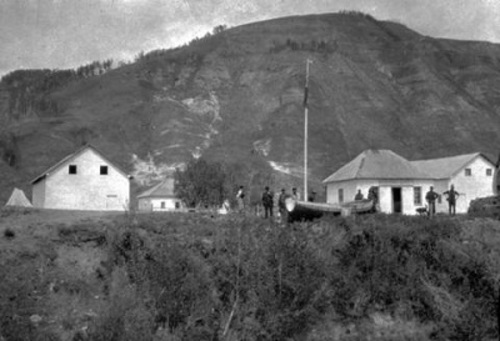
Fort Fork National Historic Site of Canada
Also known as: Fort Fork National Historic Site of Canada, Fort Fork, Fort Fork
Description
Fort Fork National Historic Site of Canada is an archaeological site located on the east bank of the Peace River, southwest of the Town of Peace River, Alberta. It sits in a wooded area about ten kilometres above the mouth of the Smoky River. There are no visible remains of the fort associated with the first transcontinental journey of Alexander Mackenzie. Official recognition refers to a semi-circle with a radius of 100 metres around the point where a line of convenience from the HSMBC cairn meets the east bank of the Peace River.
Heritage Value
Fort Fork was designated a national historic site of Canada in 1928. It is recognized because:
- it is connected with the exploration of the country and Alexander Mackenzie’s first transcontinental journey;
- Indigenous Peoples, their territories, and labour were foundational to the fur trade in North America. Posts were often built near existing Indigenous settlements, trading routes and/or meeting places and became important sites of economic, social and cultural exchange.
The heritage value of Fort Fork resides in its historical associations with the exploration of Canada, most notably by Alexander Mackenzie. Constructed in 1792, Fort Fork was the North West Company’s uppermost post on the Peace River. In May 1793, Alexander Mackenzie wintered at the fort before setting out on his historic transcontinental journey to the Pacific. In the years following, Fort Fork was used as a provisional post and was known among North West Company posts as being in good condition with a garden and extensive living quarters. With the amalgamation of the XY and the North West companies in 1804-05, Fort Fork was replaced with Fort Dunvegan National Historic Site of Canada, which was founded farther upriver.
Sources: Historic Sites and Monuments Board of Canada, Minutes, 1928, February 2010, December 2020.
Character-Defining Elements
Key elements that contribute to the heritage character of the site include:
- its location in the community of Peace River, in Alberta;
- its setting on the east bank of the Peace River, about ten kilometres above the mouth of the Smoky River;
- its siting in a natural landscape overgrown with trees and shrubs;
- the integrity of any surviving or as yet unidentified archaeological remains which may be found within the site in their original placement and extent;
- viewscapes to and from the site across the Peace River.
Gallery
1 imageLocation
Loading map...
Similar Places
Heritage sites with similar characteristics