National Historic Site of Canada
Fort Charlesbourg Royal National Historic Site of Canada
Québec, Quebec
Also known as Fort Charlesbourg Royal, France-Roi
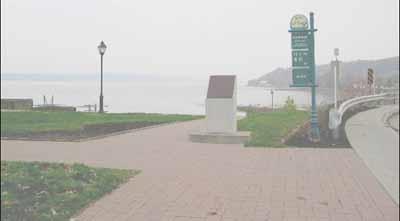
General view of the commemorative plaque at Cap-Rouge.
Photo: Parks Canada | Parcs Canada
- Built
- 1541
- Recognized
- 1923
- By
- Government of Canada
The register’s text, word for word
Description
Fort Charlesbourg Royal National Historic Site of Canada is located in Cap-Rouge, a residential suburb in the city of Québec. The site consists of the uncovered vestiges of two sixteenth-century forts: an upper fort on the treed promontory at the junction of Rivière du Cap-Rouge and the St. Lawrence River; and a lower fort situated approximately 500 metres to the northwest, on the banks of Rivière du Cap Rouge. Established in 1541 by Jacques Cartier, the forts served as the basis for the first French colony in North America, until they were abandoned in 1543. Official designation refers to the two polygons corresponding to the two archaeological excavations of the upper and lower forts.
Heritage value
Fort Charlesbourg Royal was designated a national historic site of Canada in 1923 because:
- founded by Jacques Cartier, in 1541, Charlesbourg Royal was France's first attempt to establish a colony in North America.
Established in 1541 by Jacques Cartier on his third and final voyage to the French territory along the St. Lawrence River, Fort Charlesbourg Royal consisted of an upper fort and lower fort located near the mouth of Rivière du Cap-Rouge. The upper fort, constructed at an elevation of 40 metres, offered a strategic defensive position, while the lower fort provided a potential anchorage for ships, as it was sheltered from the strong winds coming off the river. The two forts possessed a total of three towers, and the upper fort was constructed of square logs. Charlesbourg Royal was named after Charles, Duke of Orleans, the third son of King Francis I of France, and was the home of Cartier and a group of some 400 colonists during the winter of 1541-1542. This period of occupation saw difficult relations with the local Indigenous population, and many of the colonists suffered from scurvy.
In June 1542 Jean-François de la Rocque de Roberval, who had been appointed «Lieutenant-général au pays de Canada» in the previous year, arrived at the fort. That same month, Cartier decided to return to France, and Roberval took possession of the fort, changing its name to France-Roi. Archaeological evidence shows that Roberval modified some aspects of the fort to better suit the newer weaponry at his disposal. Roberval and a group of 200 colonists spent the winter in Canada, suffering from cold, famine, and disease. Although a ship was sent back to France to request assistance from the king, by summer 1543 the fort was abandoned. More than 60 years passed before another attempt was made to colonize the St. Lawrence region.
SourceHistoric Sites and Monuments Board of Canada, Minutes, 1923, 2009. Plaque text.
Character‑defining elements
Key elements that contribute to the heritage character of the site include:
- its location at the confluence of the St. Lawrence and Rivière du Cap-Rouge, which made it a geographically strategic French base;
- the setting of the upper fort’s remains on a treed promontory;
- the setting of the lower fort’s remains on the banks of Rivière du Cap-Rouge;
- the integrity of any archaeological remains, both underground, undiscovered and discovered that relate to Fort Charlesbourg Royal and its occupation by the French colonists;
- viewscapes from the former locations of either fort to the other, and over the St. Lawrence River and Rivière du Cap-Rouge.
End of the register’s text
Location
4155 de la Plage Jacques Cartier Road, Québec, Quebec, G1Y, Canada
46.74728° N, 71.34010° W
Get directions (opens in a new tab)Being on the register doesn’t make a place open to visitors. Many are private homes or businesses; please view them from the street.

Loading map…
Nearby
All 194 places in Québec
Similar places
Places whose register descriptions are closest to this one.
 Fort Charnisay National Historic Site of CanadaSaint John, New Brunswick
 Charles Fort National Historic Site of CanadaAnnapolis Royal, Nova Scotia
 EnhancedFortifications of Québec National Historic Site of CanadaQuébec, Quebec
 Fort Richelieu National Historic Site of CanadaSorel, Quebec
 Fortress of Louisbourg National Historic Site of CanadaLouisbourg, Nova Scotia
 Fort Saint-Jean National Historic Site of CanadaSaint-Jean-sur-Richelieu, Quebec
From the Canadian Register of Historic Places, as last updated on December 12, 2025. The register’s text is shown word for word.