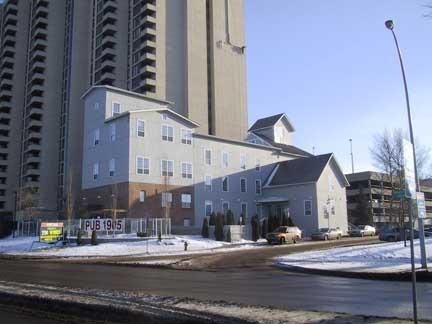
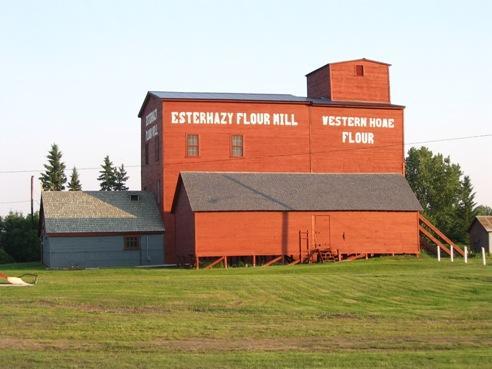
This image illustrates the north and west elevations of the building, as seen from the northwest.
Photo: City of Edmonton, 2004
- Built
- 1892–1902
- Recognized
- 1997
- By
- Local government
The register’s text, word for word
Description
The Edmonton Milling Company is a visually prominent structure consisting of several building segments that are between two- and four-storeys in height. It is located on a large city lot on the south escarpment of the North Saskatchewan River valley, facing across the North Saskatchewan River to the historical Edmonton core.
Heritage value
Constructed in 1892 and the oldest surviving flour mill in the Province, the Edmonton Milling Company is significant because of its association with the early agricultural and industrial development of Alberta. It is associated with early technical innovation, using steam-powered, steel rollers instead of the traditional stone wheels that became pitted when grinding hard prairie wheat.
The Edmonton Milling Company is also significant because of its association with industrial and agricultural development in an urban setting and with the development of the Strathcona community, one of south Edmonton's oldest settled neighbourhoods, dating from the arrival of the Calgary and Edmonton railway in 1892, which terminated at the North Saskatchewan River Valley. The Edmonton Milling Company was located at the 'End of Steel' to take advantage of the rail link with the southern part of the Province. Elevators were added in 1895 and 1902 and the building functioned as a flour mill until 1948.
The Edmonton Milling Company is also significant because of its association with Robert Ritchie who arrived in Strathcona in 1892. Within a year he had built and began operating the flour mill and added elevators in 1895 and 1905. Ritchie also served in local politics as alderman, school trustee, justice of the peace and in 1906 as mayor of Strathcona. The Edmonton Milling Company is also significant as a prominent visual landmark on the south edge of the North Saskatchewan River Valley. Its tall profile was readily visible from Edmonton across the river valley and as a landmark signified the end of the Calgary and Edmonton railway line in Strathcona.
SourceCity of Edmonton (Bylaw 11554)
Character‑defining elements
The early industrial architecture of the building is expressed in character-defining elements such as:
-form, scale and massing;
- location at 'End of Steel' on the south escarpment of the Saskatchewan River Valley;
- the configuration of the original 1892-93 three storey rectangular mill building with a regular pattern of fenestration at all floors on both the east and west elevations;
- the configuration of the south four-storey elevator with no windows and a solid appearance on the west elevation as well as a one-storey former unloading and weighing station on the east side;
- the configuration of the north, partial brick-construction, four-storey building;
- the configuration of the west two-storey addition, perpendicular to the original mill building;
- the various configurations of gable and hip roofs.
End of the register’s text
Location
10170 Saskatchewan Drive, Edmonton, Alberta, T6E, Canada
53.52360° N, 113.49439° W
Get directions (opens in a new tab)Being on the register doesn’t make a place open to visitors. Many are private homes or businesses; please view them from the street.

Loading map…
Similar places
Places whose register descriptions are closest to this one.
From the Canadian Register of Historic Places, as last updated on December 12, 2025. The register’s text is shown word for word.