Recognized Federal Heritage Building
East Mill
Smiths Falls, Ontario
Also known as Wood's Mill Complex, East Mill
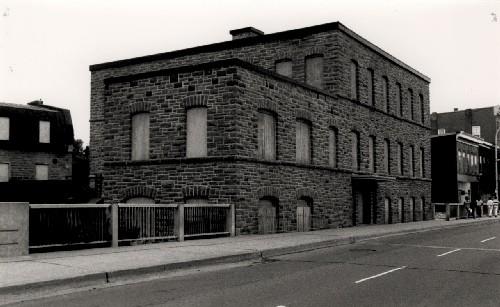
View of the East Mill, showing the regular placement of the doors and evenly spaced windows, 1972.
Photo: Agence Parcs Canada / Parks Canada Agency, 1972.
- Built
- 1890–1892
- Recognized
- 1988
- By
- Government of Canada
The register’s text, word for word
Description
The East Mill is part of the Wood’s Mill Complex located at Smiths Falls. The complex itself sits on the northern extremity of Ward’s Island adjacent to the waste weir channel of the Rideau Waterway at Smiths Falls. The large, four-storey, stone building has a flat roof, unornamented exterior walls and rows of regular windows. A smaller, two-storey office wing abuts the south façade. The designation is confined to the footprint of the building.
Heritage value
The East Mill is a Recognized Federal Heritage Building because of its historical associations, and its architectural and environmental values.
Historical Value
The East Mill, as part of a late-nineteenth-century industrial complex, is closely associated with the development of the grain milling industry in eastern Ontario. The East Mill and Wood’s Mill Complex illustrate the evolution and adaptation of grain milling from a local service industry, to one based on the processing of imported western grain and the export of the product. The industrial development of the Smiths Falls area is notable where the shift from reliance on the canal to a reliance on the railway was evident. The East Mill is associated with A.R. Ward, one of the first permanent settlers of the area and founder of the milling complex, and A. Wood, an important local entrepreneur who operated several industrial firms in the area.
Architectural Value
Valued for its good aesthetics, the East Mill exhibits a distinctly industrial character as defined by its evenly spaced fenestration pattern and its functional, flexible interior spaces. The unornamented appearance reflects the utilitarian purpose of the building. Very good craftsmanship and materials can be seen in the stone walls and in the heavy timber frame substructure.
Environmental Value
The East Mill reinforces the commercial character of its industrial complex and streetscape setting at Smiths Falls, and is a familiar landmark in the region.
SourceJames De Jonge, Wood’s Mill Complex, 34 Beckwith Street South, Smiths Falls, Ontario, Federal Heritage Buildings Review Office, Building Report 88-044; Wood’s Mill Complex, 34 Beckwith Street South, Smiths Falls, Ontario, Heritage Character Statement 88-044.
Character‑defining elements
The character-defining elements of the East Mill should be respected.
Its good aesthetic and good quality craftsmanship and materials, for example:
- the four-storey massing, the two-storey adjoining addition;
- the exterior walls of uncoursed limestone blocks;
- the heavy timber frame substructure;
- the regular placement of the doors and evenly spaced windows;
- the interior configuration.
The manner in which the East Mill reinforces the commercial character of its industrial complex and streetscape setting, and is a familiar landmark in the region, as evidenced by:
- its overall scale, design and materials, which contribute to its commercial streetscape surroundings and complement the industrial complex;
- its visibility due to its location within the streetscape at the edge of the commercial core and adjacent to a bridge and water channel.
End of the register’s text
Location
34 Beckwith Street South, Smiths Falls, Ontario, Canada
44.89830° N, 76.02100° W
Get directions (opens in a new tab)Being on the register doesn’t make a place open to visitors. Many are private homes or businesses; please view them from the street.

Loading map…
 West Millwithin 100 m · 1852
 Smiths Falls Bascule Bridge National Historic Site of Canada150 m · 1912
 Defensible Lockmaster's House200 m · Rideau Canal National Historic Site of Canada / Lieu historique national du Canada du Canal-Rideau · 1838
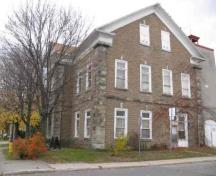 Town Hall450 m · Town of · 1859
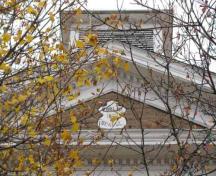 The Recreation Centre500 m · 1871
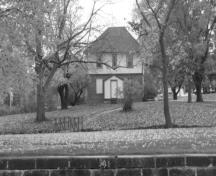 Defensible Lockmaster's House600 m · 1841
Similar places
Places whose register descriptions are closest to this one.
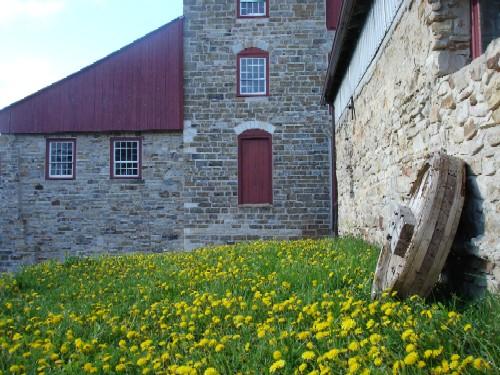 Old Stone MillVillage of Delta, Ontario
 Williams Mill/Georgetown Electric Light Company Power PlantTown of Halton Hills, Ontario
 Heritage House MuseumSmiths Falls, Ontario
 Mississippi Valley Textile MillAlmonte, Ontario
 Alexander Smith Farm ComplexTown of Caledon, Ontario
 Former Miller ResidenceBrougham, Ontario
From the Canadian Register of Historic Places, as last updated on December 12, 2025. The register’s text is shown word for word.