National Historic Site of Canada
Earthlodge Village National Historic Site of Canada
Cluny, Alberta
Also known as Earthlodge Village, Village à huttes de terre, Cluny Fortified Village
- Recognized
- 1972
- By
- Government of Canada
The register’s text, word for word
Description
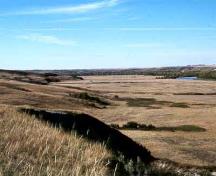
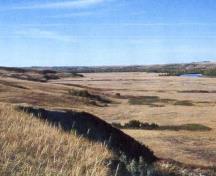
Earthlodge Village National Historic Site of Canada is a complex of earthwork features located on a grassy flat on the north bank of the Bow River near Cluny, Alberta. It consists of a semi-circular fortification ditch 250 metres long and 2.5 metres wide. The ditch, terminated on the east by an old dry channel of the Bow River, has changed shape due to erosion and flooding. Behind the ditch are a series of eleven circular “earthlodge” depressions encircling a large, central open area. The site is set entirely within the Blackfoot Crossing National Historic Site of Canada. Official recognition refers to a 30-metre perimeter surrounding the original village, as identified by the trench.
Heritage value
Earthlodge Village was designated a national historic site of Canada in 1972. It is recognized because:
- this fortified village built, ca. A.D. 1740, by an unidentified people originating from the Upper Missouri River area, is unique in Canada. [2009 Research Report]
Despite its location in the heart of Blackfoot territory, Earthlodge Village was built ca. 1740 by an unidentified people, possibly coming from the middle Missouri River region in North and South Dakota. The name “Earthlodge Village” refers to the Blackfoot name for the builders of the site rather than the site’s features. The eleven depressions within the site are different in nature from the residential earthlodge dwellings found in the middle Missouri River region, built by Siouan speakers who lived in established villages often surrounded by ditches and palisades, and whose houses were large timber frame structures covered with sod or earth. In comparison, the features at Earthlodge Village are far smaller in size than the residential structures, and the wooden palisade instead ran inside the ring of depressions. Given the placement of the palisade, it is believed that the pits were not residential, but rather defensive in nature. As a fortified village, the site is the only one of its kind in Canada, and is one of only two in the North American Plains.
SourceHistoric Sites and Monuments Board of Canada, Minutes, May 1972; October 2006; August 2009.
Character‑defining elements
Key elements relating to the heritage value of the site include:
- its location on a long-time meeting place within the limits of the Blackfoot Crossing National Historic Site of Canada, near Cluny, Alberta;
- its setting on a grassy flat on the northern bank of the Bow River;
- the relation between the outer ditch and the inner depressions;
- the integrity of any surviving or as yet unidentified archaeological remains which may be found within the site in their original placement and extent, including hearths, pottery, small baked clay discs; trade goods such as copper, glass and brass; stone tools including knives, drills, grinding slabs, mauls, hammer stones, scrapers; bone tools, beads, ornaments, punches, awls, knives, knife handles; red and yellow ochre; and faunal remains;
- viewscapes from the site across Bow River to Blackfoot Crossing National Historic Site of Canada.
End of the register’s text
Location
Blackfoot Crossing, Cluny, Alberta, T0J, Canada
50.78100° N, 112.85500° W
Get directions (opens in a new tab)Being on the register doesn’t make a place open to visitors. Many are private homes or businesses; please view them from the street.

Loading map…
Nearby
Similar places
Places whose register descriptions are closest to this one.
 British Block Cairn National Historic Site of CanadaSuffield, Alberta
 Ward Effigy Archaeological SiteNear Cluny, Alberta
 Linear Mounds National Historic Site of CanadaMelita, Manitoba
 Head-Smashed-In Buffalo Jump National Historic Site of CanadaFort MacLeod, Alberta
 Southwold Earthworks National Historic Site of CanadaSouthwold, Ontario
 Old Women's Buffalo Jump National Historic Site of CanadaFoothills, Alberta
From the Canadian Register of Historic Places, as last updated on December 12, 2025. The register’s text is shown word for word.