Provincial Historic Resource
Doukhobor Prayer Home
Lundbreck, Alberta
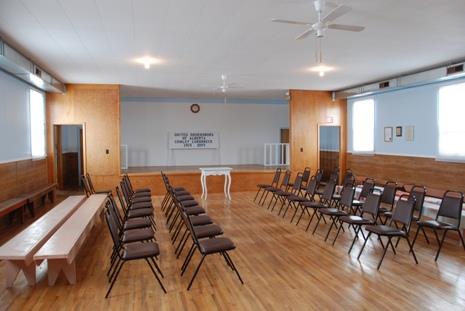
Doukhobor Prayer Home, Lundbreck
Photo: Alberta Culture and Community Spirit, Historic Resources Management Branch
- Built
- 1954
- Recognized
- 2010
- By
- Province of Alberta
The register’s text, word for word
Description
The Doukhobor Prayer Home is a simple one-storey building clad in asbestos shingles and a metal gable roof. The prayer home was constructed in 1954 with a kitchen added to the rear in 1983. The building is located on three lots in the Hamlet of Lundbreck.
Heritage value
The heritage value of the Doukhobor Prayer Home lies in its identity as one of the few remaining Doukhobor buildings remaining in Alberta and as an excellent embodiment of the historical development of the province's Doukhobor community.
Originating as a protest movement against the ritualism and materialism of the Russian Orthodox Church, Doukhoborism emphasized the inherent divinity of every person as the primary guide to human fulfillment. As such, Doukhobors unequivocally rejected the taking of human life. Persecuted by the Tsarist government for their radical commitment to pacifism, the Doukhobors sought a new land in which to live out the precepts of their faith. Aided financially and organizationally by Count Leo Tolstoy and other sympathizers, the community was allowed by the Russian government to emigrate. Having secured concessions from the Canadian government on vital issues relating to their pacifism, rejection of oaths, and desire to live communally, more than 7000 Doukhobors emigrated from the Transcaucasia region to present-day Saskatchewan in 1899.
From the start, there were divisions within the Doukhobor community around issues of accommodation to North American culture. Private property ownership and taking the oath of allegiance necessary for gaining title to land were particularly divisive. These internal divisions were aggravated by external social and political pressures. In 1907, all Doukhobor lands not conventionally acquired be thrown open to settlement. Many Doukhobors refused to file individually for their land or to take the oath of allegiance necessary to acquire a homestead. These individuals were dispossessed of their land. More than half of the Saskatchewan Doukhobors relocated to British Columbia. There they established several colonies and prospered. Success led to the creation of new communities, including the first Alberta colonies established in 1915 in the Cowley / Lundbreck area. Buoyed by a robust internal economy within the community that saw goods shipped between the colonies in the three western provinces, the Doukhobors continued to grow. The murder of the Doukhobor's leader, Peter the Lordly Verigin, in 1924, the economic hardships of the Depression, internal fragmentation during the 1920s and 30s, and the suspicions and antagonism of some of Alberta's political and social leaders devastated the community and led National Trust and the Sun Life Assurance Company to initiate foreclosure proceedings against Doukhobor communal assets in the three prairie provinces in order to secure a relatively small debt. This act effectively ended the Doukhobors ability to hold land communally.
The Doukhobor Prayer Home in Lundbreck is a remarkable building that embodies the tensions between the traditional and the modern, radicalism and accommodation, communalism and individualism, in Doukhobor culture, particularly after the devastating 1938 foreclosure. The prayer home is a simple structure constructed of modern materials and resembling a typical period community hall. Its lack of embellishment is consistent with the Doukhobors' rejection of religious iconography, but the building lacks the meticulous, lively woodwork that distinguished earlier Doukhobor buildings and embodied the community's commitment to sanctification through work. The interior space is separated by two banks of benches that divide men and women. As the earliest Doukhobors were largely illiterate and their worship services were devoted to the singing of hymns, there are few books present in the building. The wall features a number of documents - including documents registering the Doukhobors and their prayer home under state law, as well as several community certificates of achievement - that speak to the tendency of mid-century Doukhobors to engage the larger culture.
SourceAlberta Culture and Community Spirit, Historic Resources Management Branch (File: Des. 2273)
Character‑defining elements
The character-defining elements of the Doukhobor Prayer Home include such features as:
- location in Lundbreck, a focus for Doukhobor settlement in the early twentieth century;
- simple, utilitarian construction that embodies both the practicality and iconoclasm of the
Doukhobor community;
- modern materials, including asbestos shingles and metal roofing, that express the mid-
century shift from traditional materials and construction methods of first-generation;
Doukhobors to the new architectural vision of second- and third-generation
Doukhobors;
- strikingly plain interior space reflective of the Doukhobors' iconoclasm;
- legal documents on the walls and certificates of achievement which speak to the greater
tendency of mid-century Doukhobors to engage and integrate into the larger culture;
- kitchen addition essential for the demonstrations of hospitality so central to Doukhobor culture.
End of the register’s text
Location
753 Kettles Street, Lundbreck, Alberta, Canada
49.58407° N, 114.16152° W
Get directions (opens in a new tab)Being on the register doesn’t make a place open to visitors. Many are private homes or businesses; please view them from the street.

Loading map…
Nearby
 Drewry House3.7 km · near Cowley · 1910
 Leitch (Passburg) Collieries12 km · near Burmis · 1906
 West Canadian Collieries Mine15 km · Near Crowsnest Pass - Bellevue · 1903
 Old Hillcrest Cemetery16 km · near Crowsnest Pass - Hillcrest
 Frank Slide17 km · Near Crowsnest Pass - Frank
 Village of Lille19 km · Near Crowsnest Pass · 1903
Similar places
Places whose register descriptions are closest to this one.
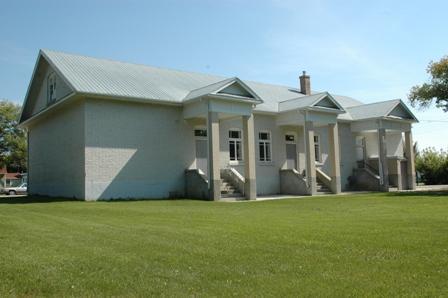 Doukhobor Prayer HomeBlaine Lake, Saskatchewan
 Veregin Doukhobor Prayer HomeVeregin, Saskatchewan
 Doukhobors at Veregin National Historic Site of CanadaVeregin, Saskatchewan
 Irricana United ChurchNear Irricana, Alberta
- former Rose Valley United ChurchRose Valley, Prince Edward Island
 St. John the Evangelist Ukrainian Catholic ChurchPrud'homme, Saskatchewan
From the Canadian Register of Historic Places, as last updated on December 12, 2025. The register’s text is shown word for word.