Community Heritage Register
Courtenay Public Library
Courtenay, British Columbia
Also known as Vancouver Island Regional Library, Courtenay Branch
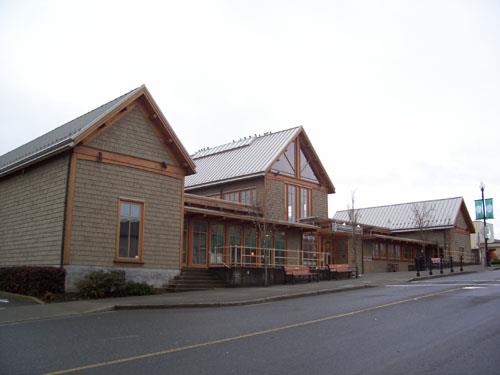
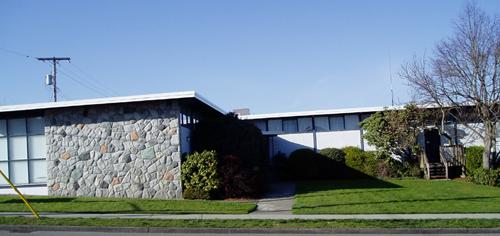
Courtenay Public Library
Photo: City of Courtenay, 2009
- Recognized
- 2009
- By
- Local government
The register’s text, word for word
Description
The Courtenay Public Library is a contemporary, one-storey, wooden-clad building prominently located at the intersection of 6th Street and Duncan Avenue in the heart of Courtenay’s historic downtown district. The building is used as a public library, and features surrounding landscaping including several trees planted in the front of the building’s entrance.
Heritage value
The Courtenay Public Library is valued for its historic and aesthetic significance, particularly for its association with Courtenay’s early agricultural economy, and its modern Arts and Crafts-inspired architecture.
The Courtenay Public Library’s value lies in its association with the Comox Valley Co-operative Creamery Association Building, which originally occupied the historic site from 1901 to 1968. The Creamery was a prominent landmark in the City, and played a central role in Courtenay’s early economic and social development. The Creamery Association was formed by local dairy farmers in 1901 with the specific intent to produce and market local butter. After a decade, Comox Creamery Butter was renowned throughout the Province for its high quality, thanks to the work of butter-maker William Carroll. The social significance of the Creamery was vested in the Creamery whistle which served as the unofficial timekeeper for Courtenay’s downtown businesses and residents for more than half a century.
The Courtenay Public Library’s has aesthetic values relating to its architecture, extensive use of wood throughout the exterior and interior of the building, and the building’s prominent setting. Constructed in 2001, the building is a unique example of a modern interpretation of the Arts and Crafts style in Courtenay, which is demonstrated by a high quality of craftsmanship featuring warm and inviting interior open spaces, massive timber frame and use of rustic wooden accents throughout the building. It is also significant that the building was specifically designed to recollect the character of the Comox Co-operative Creamery Building, seen in the use of wood shingles and clerestory windows. Wood cladding over the entire building exterior serves as a fitting reminder of the forestry sector, which has played a pivotal role in the social and economic development of the City of Courtenay. The situation of the library in the heart of Courtenay’s downtown core makes the building a significant landmark in the community.
SourceCity of Courtenay Planning Department
Character‑defining elements
Key elements which define the heritage character of the Courtenay Public Library include its:
Site and Setting
- the elevated position of the building, which adds to the prominence of the building
- prominent location in Courtenay’s historic downtown
- setback position of the library facilitates an open courtyard and accompanying landscaping
Architecture
- horizontal form, rectangular scale and massing, expressed by its modest one storey height
- elements that reflect the building’s contemporary interpretation of the Arts and Crafts style, including open and inviting interior spaces, substantial interior timber frame, exposed rafters, and use of subtle wood accents throughout the building
- extensive use of wood throughout the exterior and interior of the building, including cedar shingled siding and roofing, wooden louvres, and timber frame
- extensive fenestration, including multi-paned windows with wooden casements
- elements of the building which are sympathetic to the ‘Creamery’ building which occupied the historic site including wood shingles and clerestory windows
End of the register’s text
Location
300 Sixth Street, Courtenay, British Columbia, V9N, Canada
49.68980° N, 124.99841° W
Get directions (opens in a new tab)Being on the register doesn’t make a place open to visitors. Many are private homes or businesses; please view them from the street.

Loading map…
Similar places
Places whose register descriptions are closest to this one.
From the Canadian Register of Historic Places, as last updated on December 12, 2025. The register’s text is shown word for word.