Cap-des-Rosiers Lighthouse National Historic Site of Canada
Also known as: Phare de Cap-des-Rosiers, Cap-des-Rosiers Lighthouse National Historic Site of Canada, Cap-des-Rosiers Lighthouse
Description
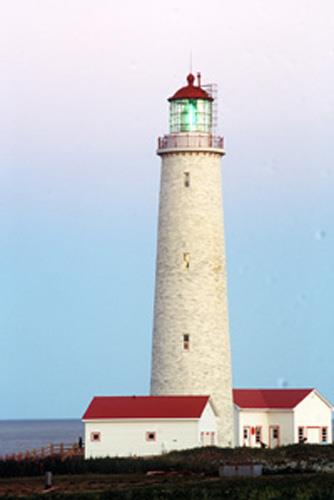
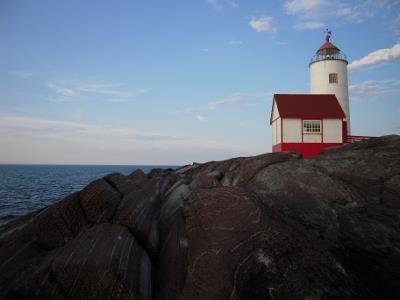
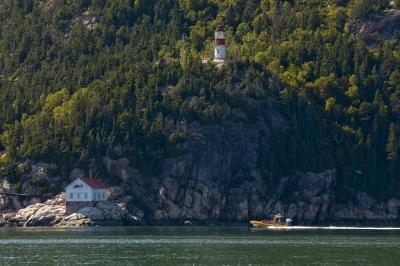
This thirty-seven metre high stone light-tower is perched atop rugged cliffs near the village Cap-des-Rosiers, Québec. The exposed point of land is at the mouth of the St. Lawrence River where it enters the Gulf of St. Lawrence. Witness to many shipwrecks, the lighthouse continues to guide ships navigating these treacherous waters. The designation refers to the interior and exterior of the lighthouse. Tourists are welcome to visit the lighthouse today.
Heritage Value
Cap-des-Rosiers Lighthouse was designated a national historic site because
- it was part of a series of tall tapering towers constructed in the Gulf of St. Lawrence and on Lake Huron by the Minister of Public Works; and
- its 112 foot (34.1 metres) height makes it the tallest lighthouse in Canada.
The heritage value of Cap-des-Rosiers Lighthouse lies in its siting, design, construction and materials. Its impressive height and tapering profile are archetypical lighthouse qualities. Cap-des-Rosiers Lighthouse was designed by John Page, Chief Engineer of the Department of Public Works of the United Canadas, and built by contractor Charles François-Xavier Baby in 1853-1858. Since 1858 it has operated using its original optical apparatus although the technology of its light has changed from a catadioptric fixed white light (1858-1903), incandescent vapour petroleum light (1903-1921), a Canadian burner lamp (1921-1950), a manually operated electric lamp (1950-1972), a partially automated light (1972-1981), then a completely automated light (1981-2004). Its tower was coated with stucco in 1861, 1881 and 1897, and repaired in 1929-30, 1954 and 1984. Windows were replaced in 1884, and its stonework repaired in 1993.
Source: Historic Sites and Monuments Board of Canada, Minutes, 1974.
Character-Defining Elements
Key elements contributing to the heritage value of this site include:
- its rugged, exposed site atop high cliffs on a point of land separating two major bodies of water;
- the soaring silhouette and solid massing of the lighthouse as a tall tapered circular tower capped by a prominent light with a large dome-covered metal lantern;
- the sparse simplicity of its features (small window openings, small brackets supporting the lantern gallery);
- the functional interior design including the spiral staircase in its 9-storey interior;
- the integrity and craftsmanship of its materials (white marble stonework, cement /stucco finish, English firebrick interior, metal lantern);
- its solid, fireproof stone construction;
- its lighting apparatus including surviving original optical apparatus and evidence of earlier lighting technologies;
- its unobstructed viewscapes over the waters of the St. Lawrence River;
- the triangular configuration of its site,
- the layout and organization of the lighthouse site including the location, function, materials and forms of other buildings and structures at the station in relation to the tower (two large buildings, a tall antenna, fog alarm, generator and battery buildings and a small shed),
- archaeological evidence of former buildings and structures at the station and their spatial and functional relationship to earlier modes of station operation,
- the viewplane arc of the sweep of the light from the tower over the water,
- the viewplanes from the lighthouse over the St. Lawrence River and the Gulf of St. Lawrence,
- viewplanes from the lighthouse to the village of Cap-des-Rosiers,
- the status of the lighthouse as a longterm landmark from the Gulf of St. Lawrence, the St. Lawrence River, and the village of Cap-des-Rosiers.
Gallery
1 imageLocation
Loading map...
Similar Places
Heritage sites with similar characteristics