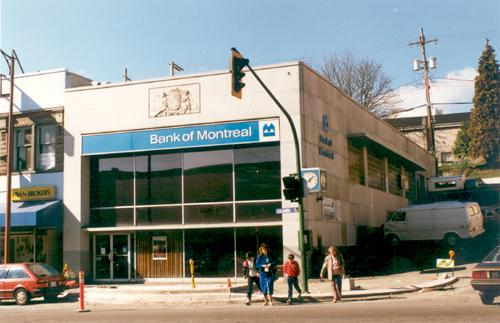
Bank of Montreal
Also known as: Bank of Montreal, Molson's Bank, 3 King Street South
Description
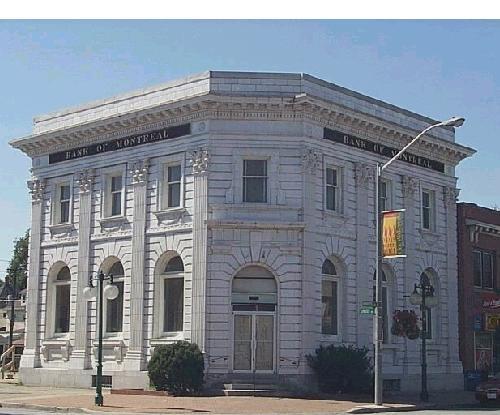
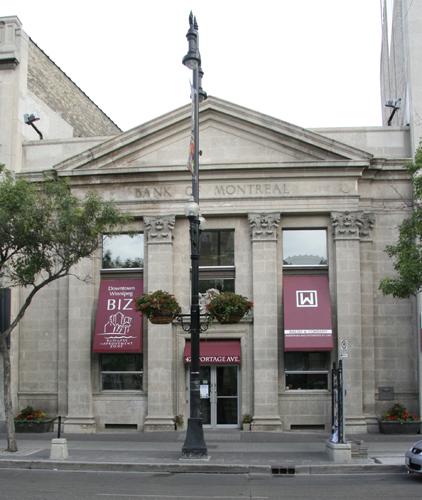
The Bank of Montreal, formerly known as the Molson's Bank, is on King Street South in Uptown Waterloo. The building is located on the southwest corner of King and Erb Streets. The large grey-stone building was designed in 1914 in the Beaux Arts style by the architects Langley and Howland of Toronto.
The building has been designated for its historic and architectural value by the City of Waterloo under Part IV of the Ontario Heritage Act, By-law 81-11.
Heritage Value
The Bank of Montreal is the oldest banking establishment in Waterloo with the first branch operating as early as 1860. In 1881, the first Molson's Bank branch opened in Waterloo and in 1898 relocated to Uptown. The land upon which the Bank of Montreal is located was privately owned by William Snider and functioned as a town square beginning in 1816. The City council refused the offer to buy the land from William Snider, and in 1914 the land was sold to Molson's Bank. In 1914, the new Bank building was constructed and in 1925, the Molson's Bank merged with the Bank of Montreal.
The Bank of Montreal is the last standing bank building designed in the Beaux Arts architectural style in Kitchener-Waterloo. The building has a heavy, massive character with a mixture of classical elements, such as the engaged Ionic columns and recessed transom. Its architecture symbolizes the highly respected image of banking institutions in Waterloo. The Montreal Bank is a monument on King Street symbolizing the highly respected image of bank institutions. It dominates the commercial vista of Uptown Waterloo.
Sources: Designated Landmarks City of Waterloo, LACAC, 1995; City of Waterloo By-law 81-11.
Character-Defining Elements
Character defining elements that contribute to the heritage value of the Bank of Montreal include its:
- integration of the Bank of Montreal and Molson's Bank;
- the privately owned land's significance to the community as a town square;
- cut grey stone;
- Ionic columns;
- curved stone pediments over the windows;
- dentils on the cornice;
- recessed transom;
- keystones;
- eared trim;
- architrave (title block);
- entablature in the form of cornice;
- plinths at the base of the building;
- decorated lugsills;
- prominent situation at the intersection of King and Erb Streets in Uptown Waterloo.
Gallery
2 imagesLocation
Loading map...
Similar Places
Heritage sites with similar characteristics