Backhouse Grist Mill National Historic Site of Canada
Also known as: Backhouse Grist Mill National Historic Site of Canada, Backhouse Grist Mill, Moulin-à-Farine Backhouse
Description
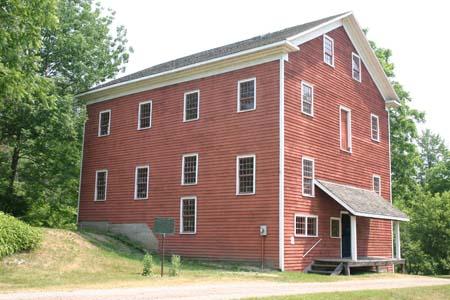
Located within the Backus Heritage Village, the rural setting and rushing stream beside the mill speaks to the industry and economic life of Upper Canada’s earliest pioneer communities. Its large, simple volume, hand-hewn timber frame and surviving machinery are an enduring reminder of the origins of Canada’s agricultural sector. The official recognition refers to the mill, including the one-storey office appended to the northern façade, with its associated machinery within the footprint of the building.
Heritage Value
Backhouse Grist Mill was designated a national historic site of Canada because:
- it is one of the oldest and best preserved examples remaining in Canada of the small-scale, water-powered establishments found throughout much of the country in the 19th and early 20th centuries;
- this wooden building survived two centuries of continued use and is furnished with a collection of operable equipment closely associated with the most important technological changes in 19th century milling history;
- it also reflects two stages of Canadian milling history - the early custom mill which prevailed on the settlement frontier, and the small-output, but more commercial, grist mill common in the countryside in later years; and
- the mill endures today as a reminder of early flour milling in Canada, a pursuit which later grew into one of the country's most important industries.
This rare technological and architectural survivor of early grain milling in Upper Canada was built by John Backhouse (or Backus) in the 1790s and remained operational until 1957. Typically found in frontier agricultural communities of the early 19th century, such heavy timber-framed structures used water power to mill grain. More contemporary machinery, added in the later 19th and early 20th centuries, was common in small-scale, commercial establishments in the countryside. These mills marked the beginning of what became one of Canada’s major industries.
Sources: Historic Sites and Monuments Board of Canada, Minutes, July 1998 and November 2001.
Character-Defining Elements
Aspects of this site which contribute to its heritage value include features of the building that speak to its role as a late 18th century mill that evolved over time, namely:
- its siting on the bank of a stream associated with power generation;
- its three-storey rectangular massing under a pitched roof;
- its heavy timber frame and wood clad construction on a rubble stone foundation;
- the functional and nonsymmetric arrangement of openings;
- the multi-pane sash windows;
- its rectangular plan and gable roof;
- the functional nature of its interior layout;
- its interior wall finish of plain wide boards;
- its surviving milling machinery and equipment.
Gallery
1 imageLocation
Loading map...
Similar Places
Heritage sites with similar characteristics