Municipal Heritage Building, Structure or Land
Alexander Mortuary Chapel of All Souls and Cemetery Municipal Heritage Site
Bonavista, Newfoundland and Labrador
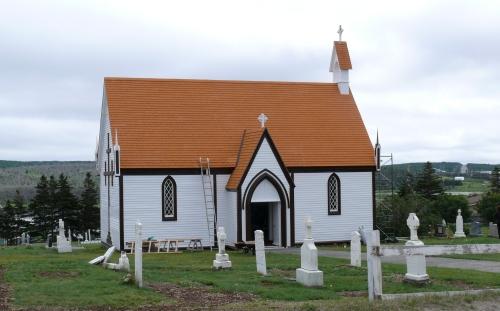
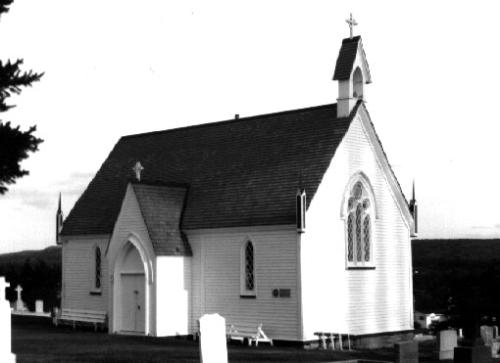
Front view of the Mortuary Chapel with the remnants of the lich-gate in the foreground, Bonavista, NL, 2006/06/14.
Photo: L Maynard/HFNL 2006
- Built
- 1897–1901
- Recognized
- 2006
- By
- NL Municipality
The register’s text, word for word
Description
Alexander Chapel of All Souls, also referred to as the Church of England Mortuary Chapel or simply the Mortuary Chapel, is a single storey, steep gabled, wooden chapel in Gothic Revival style. It is surrounded by a cemetery on its grassy grounds. The municipal heritage designation includes the building and cemetery land at 031-049 Coster Street, Bonavista, NL.
Heritage value
The Alexander Chapel of All Souls and Mortuary Chapel Cemetery site has spiritual value given its significance to the Anglican Parish of Bonavista. The site also holds a combination of historic, architectural, and environmental values.
Alexander Chapel has historic value as one of only two known remaining mortuary chapels in the province. The cemetery complements the historic funerary function of the Mortuary Chapel. It also has historic value in its own right, given the information recorded on its gravemarkers. Several headstones indicate the deceaseds’ military service, recording pieces of military history. A headstone near the cemetery entrance recalls two young men whose bodies were recovered after a Norwegian ship sank in Bonavista Bay during a storm in 1907, underscoring Bonavista's connection with the sea as a coastal community. Another marks the gravesite of Mrs. and Canon Bayley, who was Rector of the parish for more than thirty years.
Alexander Chapel of All Souls is representative of the longstanding architectural collaborations of the Strathie and Alexander families in Bonavista. The chapel’s namesake, William Alexander, was a prominent Scottish merchant whose daughter, Isabella, willed funds to the then Church of England Parish towards construction of the building. Ronald Strathie was the most prominent of a family of builders and carpenters in the Bonavista area, and was commissioned to work on the Alexander Chapel in 1897.
Alexander Chapel of All Souls is architecturally valuable as a good example of Gothic Revival style adapted for a small rural chapel, with its spires, steep roof, pointed arch door and windows, stained glass, interior open timber roof, and wood construction. There is also a stepped Cross Crosslet embedded in the back of the building. Such Gothic style became popular for Anglican church buildings in Newfoundland around the mid-nineteenth century.
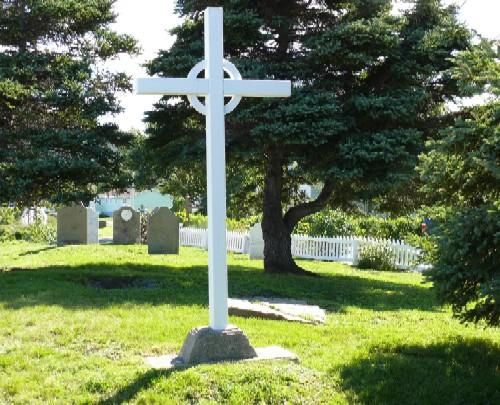
The Alexander Chapel of All Souls and Mortuary Chapel Cemetery site has environmental value as it is one of a number of cemeteries consecutively located along Coster Street, amongst which it is distinguishable by its distinctive entrance, landmark chapel, and age. The entire site is delineated by wooden fencing with a decorative wrought iron gate at the entrance. The remnant of a lich-gate there is a noteworthy feature. Such gates traditionally mark a churchyard entrance and the path along which a body is carried during the initial part of a burial service. They may be used as a cover under which to remove a coffin from a hearse or as a stop at which to pray.
Some grave plots in the Mortuary Chapel Cemetery are delineated by low iron or wooden fencing, or concrete. Most gravemarkers are tablet forms in white marble, typical of the headstones of the period during which the site was most heavily used for burials (late nineteenth to mid-twentieth century). Accordingly, there are also some column forms in gray marble and comparatively fewer granite ones, as well as some wooden markers.
Historically popular cultivated flora including lilac bushes, shrub roses, forget-me-nots, lily of the valley and columbine feature amongst the natural topography of the cemetery grounds, and a number of mature coniferous trees stand at the perimeters.
SourceTown council meeting minutes, Town of Bonavista, 2006/08/14
Character‑defining elements
All those features related to the function of the chapel and cemetery, and those design features characteristic of the Gothic Revival style of religious architecture in Newfoundland, including:
-pointed arch window shape and style;
-pointed arch door;
-spires;
-steep roof;
-stained glass;
-interior open timber roof;
-building height, massing and dimensions;
-stepped cross crosslet in rear of building;
-and wood sheathing.
And those features of the chapel grounds and cemetery which reflect the site’s age and historic function in connection with the chapel:
-types, placement, and materials of gravemarkers and plot markers;
-natural topography;
-location and style of the lich-gate;
-and the placement of the path from the lich-gate to the front door of the chapel.
End of the register’s text
Location
Bonavista, Newfoundland and Labrador, A0C, Canada
48.65195° N, 53.11325° W
Get directions (opens in a new tab)Being on the register doesn’t make a place open to visitors. Many are private homes or businesses; please view them from the street.

Loading map…
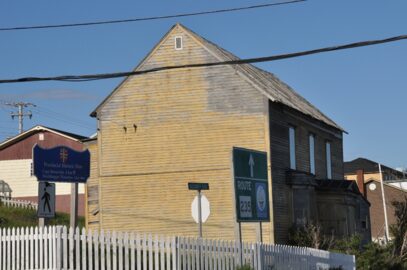 EnhancedWilliam Alexander House Registered Heritage Structurewithin 100 m
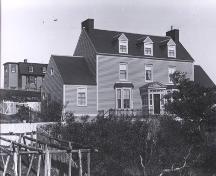 William Alexander House Municipal Heritage Buildingwithin 100 m · 1811
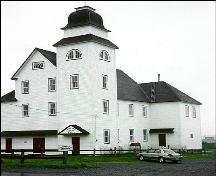 Loyal Orange Lodge LOL #4150 m · 1907
 Loyal Orange Lodge LOL #4 Municipal Heritage Building150 m · 1907
 Jubilee House Municipal Heritage Building150 m
 Lawrence Cottage Municipal Heritage Building150 m
Similar places
Places whose register descriptions are closest to this one.
 Alexander Chapel of All Souls Mortuary ChapelBonavista, Newfoundland And Labrador
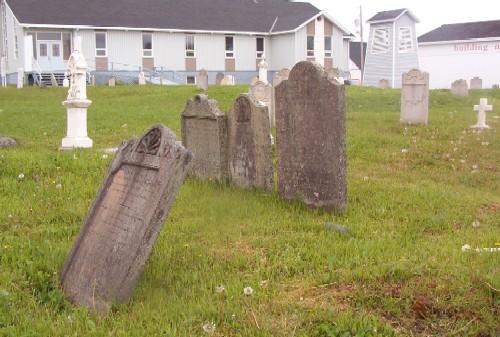 Christ Church Churchyard Cemetery Municipal Heritage SiteBonavista, Newfoundland And Labrador
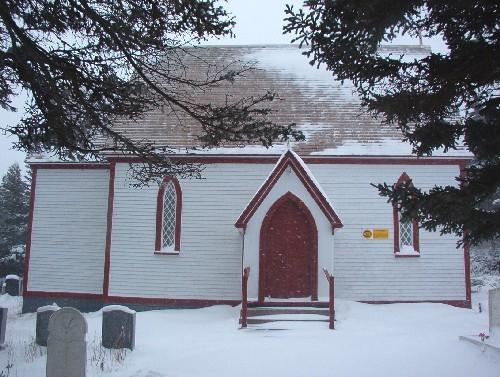 St. Mary's Anglican Church and Cemetery Municipal Heritage SiteElliston, Newfoundland And Labrador
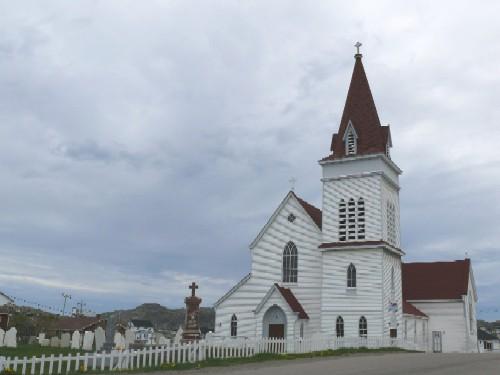 St. Andrew's Anglican Church and Cemetery Municipal Heritage SiteFogo, Newfoundland And Labrador
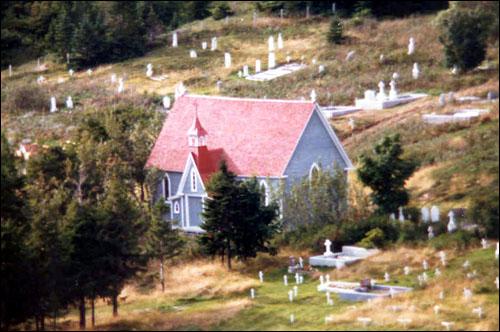 Mortuary ChapelTrinity (Trinity Bay), Newfoundland And Labrador
 Chapel Cemetery Municipal Heritage SiteHolyrood, Newfoundland And Labrador
From the Canadian Register of Historic Places, as last updated on December 12, 2025. The register’s text is shown word for word.