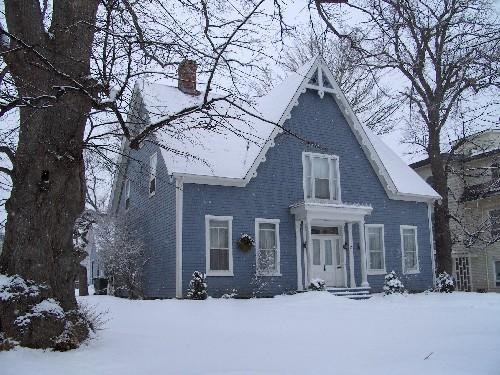
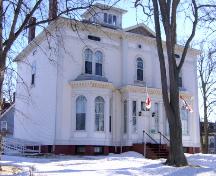
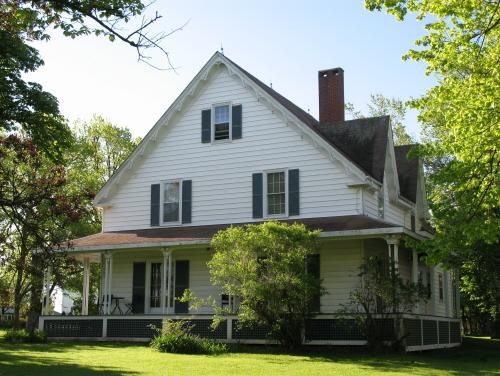
Showing south west elevation
Photo: City of Charlottetown, Natalie Munn, 2005
- Built
- 1863
- Recognized
- 1979
- By
- City of Charlottetown
The register’s text, word for word
Description
The W.W. Lord House is a Gothic Revival influenced home located at 17 Water Street. It was built in 1863 for Member of the Legislative Assembly and merchant, William Warren Lord (1798-1890). The designation encompasses the building’s exterior and parcel; it does not include the building’s interior.
Heritage value
The W.W. Lord House’s heritage value resides in its association with prominent Island merchant and MLA, W.W. Lord and its well preserved architecture.
W.W. Lord was born into a Loyalist farming family in the community of Tryon. As a young man, he traveled to New Brunswick, where he worked as a lumberman. He eventually returned to Tryon where he became a successful businessman. Among his business interests were shipbuilding, insurance, as well as an inn and tavern. In 1841, Lord left Tryon for Charlottetown where he opened a general store, constructed a wharf and continued in the shipbuilding business. He was active in other companies as well, serving as a director of the Union Bank of Prince Edward Island, the Bank of Prince Edward Island, the Charlottetown Mutual Fire Insurance Company and the Marine Insurance Company of Prince Edward Island. It is interesting to note that Lord was instrumental in bringing Charles E. Stanfield, of Stanfield’s Ltd. fame to Prince Edward Island. Although Stanfield later based his company out of Truro, Nova Scotia, he opened the first woolen mill on Prince Edward Island in Tryon, with Lord as a minor partner in the venture. In addition to his business activities, Lord had a keen interest in politics. An active Liberal in Province’s legislature, Lord represented various ridings in Prince County at different points in his political career.
The Gothic Revival home with its center gable and decorative bargeboard was fashionable when it was built in 1863. Although added later, the iron cresting on the porch adds to the attractiveness of the home. A sympathetic renovation in 1963 has helped the home retain its attractive details. The home has changed hands a number of times throughout its history, however it still remains a residence to this day.
SourceHeritage Office, City of Charlottetown Planning Department, PO Box 98, Charlottetown, PE C1A 7K2 Record # 1264
Character‑defining elements
The heritage value of the W.W. Lord House is reflected in the Gothic Revival influenced character defining elements:
- The placement and style of the windows, including the first floor facade two over two windows with transom lights at the top, as well as the central second floor window with side transom lights
- The placement and style of the doors, including the centrally placed front door with side and top transom lights
- The centrally placed porch with its iron cresting
- The decorative bargeboard trim, including the verge loops
- The steeply pitched roof, as well as the centre gable
- The placement of the two chimneys
- The wooden siding
- The overall symmetry of the façade
End of the register’s text
Location
17 Water Street, Charlottetown, Prince Edward Island, C1A, Canada
46.23066° N, 63.12724° W
Get directions (opens in a new tab)Being on the register doesn’t make a place open to visitors. Many are private homes or businesses; please view them from the street.

Loading map…
Similar places
Places whose register descriptions are closest to this one.
 166 Weymouth StreetCharlottetown, Prince Edward Island
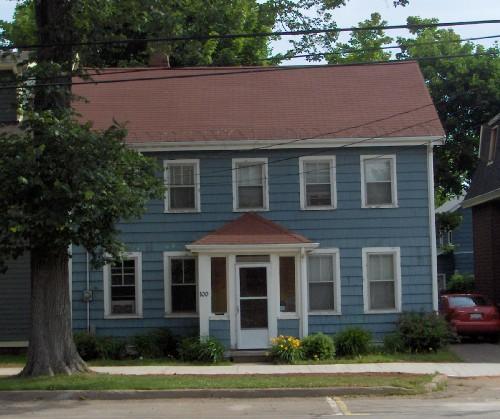 100 Prince StreetCharlottetown, Prince Edward Island
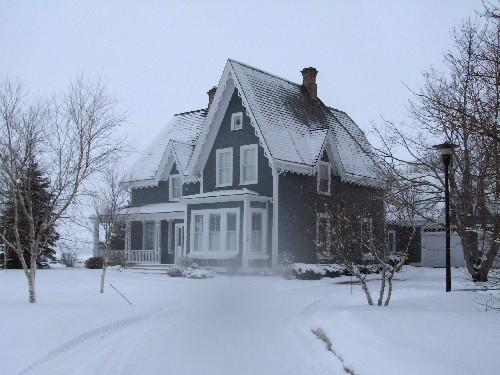 Watermere / 5 Queen Elizabeth DriveCharlottetown, Prince Edward Island
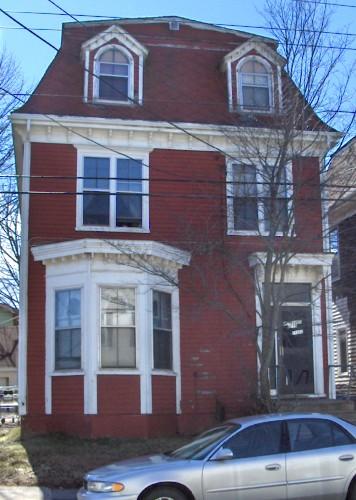 93 Weymouth StreetCharlottetown, Prince Edward Island
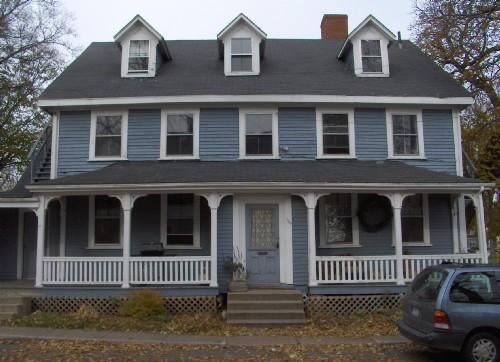 187-189 Dorchester StreetCharlottetown, Prince Edward Island
 2 Water StreetSummerside, Prince Edward Island
From the Canadian Register of Historic Places, as last updated on December 12, 2025. The register’s text is shown word for word.