Wentworth Valley Schoolhouse
Description
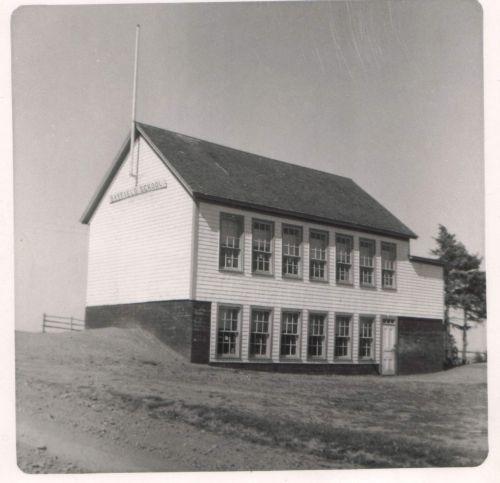
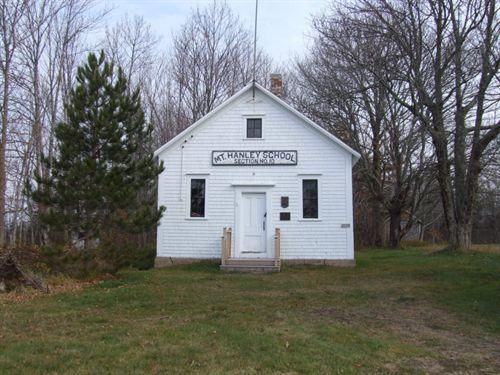
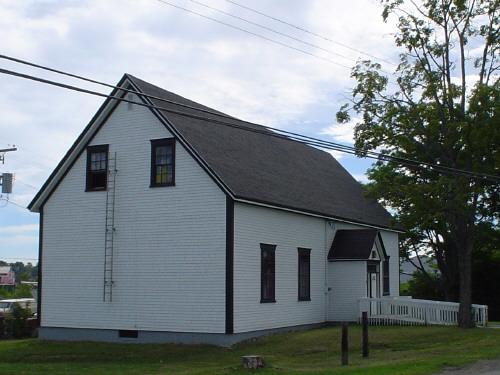
The Wentworth Valley Schoolhouse is a modest, one-storey, one-room schoolhouse that has been converted into a community hall. It sits on its original location near a number of cottages on a rural road in the Wentworth Valley. The building is set well-back off the road on a large lawn beside a stream and is backed by trees and bushes. The building and property are included in the municipal designation.
Heritage Value
The Wentworth Valley Schoolhouse is valued for being a good example of a typical, turn-of-the-century, Cumberland County rural schoolhouse. As with many schools of this area and era, it is a one-room, one-storey, rectangular symmetrical structure. It has three rectangular windows in each of the non-gabled sides, and two windows in the front gable end. The building is unadorned except for the prominent lintels over each window, the corner boards, and the decorative triangular ventilation window in the peak of the front-facing gable.
The school is now used as a community centre, but it was used as a local school until 1958. This building was built in 1903 to replace the original 1871 schoolhouse. Dr. Ross Barclay attended the school in the 1940s. He was a Rhodes Scholar, a widely-renowned science researcher, and a chemistry professor at Mount Allison University. The University’s L.R.C. Barclay Science Building is named for him.
Source: “Heritage Properties County, Wentworth Valley Schoolhouse” File, Cumberland County Museum
Character-Defining Elements
Character-defining elements of the Wentworth Valley Schoolhouse include:
- wood construction;
- original location, size and massing;
- wooden clapboard siding;
- medium-pitch gabled roof;
- unadorned except for the corner boards and the prominent lintels over windows;
- sign on the gable end saying “WENTWORTH VALLEY No 14”.
Gallery
3 imagesLocation
Loading map...
Similar Places
Heritage sites with similar characteristics