Provincially Recognized Heritage Site (Recognized)
Tod Inlet
Brentwood Bay, British Columbia
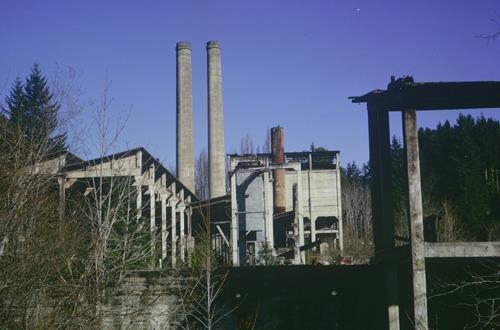
Remains of cement plant, 1960s. Photo courtesy of David R. Gray.
Photo: David R. Gray
- Built
- 1904
- Recognized
- 2016
- By
- Province of British Columbia
The register’s text, word for word
Description
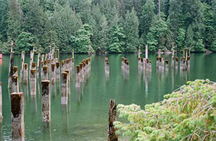
The remains of the former community of Tod Inlet are situated within the boundaries of Gowlland-Tod Provincial Park in the municipalities of Saanich and Central Saanich on southern Vancouver Island, British Columbia. Located on the north and east sides of a small body of water also known as Tod Inlet, the site is bounded on the north by Interurban Road and on the west by Benvenuto Avenue. It is located adjacent to Butchart Gardens, a former limestone quarry that is now a world-famous tourist destination. The quarry originally supplied a cement plant that was the focus and reason for existence of the Tod Inlet community. Today, Tod Inlet includes the remnants of the cement plant and its associated worker housing, now abandoned and overgrown by the encroaching forest: concrete building foundations, moss-covered objects left by workers at the cement plant, and wooden wharf pilings that jut into the water of the inlet. An extensive, well-maintained trail system within the Provincial Park follows former footpaths once used by Chinese and other workers.
Heritage value
Tod Inlet has historical, cultural, scientific, social and spiritual values associated with its operation as the former workplace and residential village for a group of ethnically diverse workers at the Vancouver Portland Cement Company, and for its association with B.C.'s industrial development.
Constructed in 1904, the former community of Tod Inlet is historically significant as the location of the first cement factory on the west coast and its associated limestone quarry and clay mining site. The complexity of the cement manufacturing process and the infrastructure required to produce it can be seen in the physical arrangement of the partial remains of the plant and other historic resources on the site. The quarries were connected to the plant by a tramline, and scows transported the finished cement from the substantial wharf. Coal to fuel the kilns was shipped here from Nanaimo.
Tod Inlet is culturally significant as the former workplace and workers' village for Chinese Canadian, South Asian Canadian, and First Nations employees of the Vancouver Portland Cement Company. It was part of a segregated community that also included white engineers, managers and plant workers and their families.
Tod Inlet is valued as an illustration of typical living and working conditions in Chinese Canadian worker communities associated with B.C.'s remote industrial sites, including the bunkhouses and temporary quarters that were a common fixture of these remote workplaces. In contrast to the accommodations provided for white employees, Chinese Canadian living arrangements were communal, with four to six men living in each bunkhouse and meals eaten in one large building.
As a place that saw many industrial accidents and deaths from high-risk work, as well as diseases such as typhus and tuberculosis due to substandard housing for Chinese and South Asian workers, Tod Inlet represents the sacrifice many Chinese workers made on early work sites in B.C., often for lower pay than their European counterparts.
The prominence of the remaining industrial plant structural foundations, wharf pilings and remnant objects once used and discarded by Chinese Canadian and other workers make Tod Inlet significant as a unique representation of the past. Objects regularly unearthed by park visitors such as boots, ceramics, cookware, buckets and other items reflect the lifestyles of the people who worked and lived there.
Artifacts visible along the walking trails are important because they provide a unique hiking experience, as are the decomposing moss-covered structural remains that create an atmosphere of mystery and wonder. Current park trails follow footpaths which were once the main thoroughfares for Chinese Canadian workers as they walked from their homes to the cement plant.
These remaining features also demonstrate the site's scientific value for industrial archaeological investigations. Because the cultural elements have been protected within a provincial park, the place has the potential to reveal considerable information about the former community. Also significant are the many artifacts from this site that are held in local museums.
Tod Inlet has spiritual value as a place where many Chinese Canadian workers died in the course of their work, while oral histories describe funeral processions leaving the place.
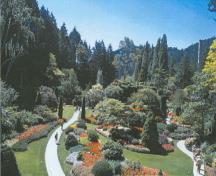
The former community of Tod Inlet is further valued for its geographical and historical association with the adjacent Butchart Gardens, developed on the site of the limestone quarry that supplied the cement plant. After the cement plant closed in 1921, Chinese Canadian workers from Tod Inlet were employed at Butchart Gardens. Today, Butchart Gardens is a world-famous tourist destination and National Historic Site.
SourceProvince of British Columbia, Heritage Branch
Character‑defining elements
Not applicable.
End of the register’s text
Location
Brentwood Bay, British Columbia, Canada
48.56054° N, 123.46655° W
Get directions (opens in a new tab)Being on the register doesn’t make a place open to visitors. Many are private homes or businesses; please view them from the street.

Loading map…
Nearby
 Tod Inletwithin 100 m · 1904
 Butchart Gardens National Historic Site of Canada400 m · Saanich · 1904
 Norfolk Lodge4.1 km · Saanich · 1908
 Millstream Lake Road - Ross Durrance Road4.6 km · Highlands · 1918
 Second Lake Dam5.5 km · Highlands
 Dominion Astrophysical Observatory National Historic Site of Canada5.8 km · Victoria · 1914
Similar places
Places whose register descriptions are closest to this one.
 Butedale CanneryButedale, British Columbia
 Victoria ChinatownVictoria, British Columbia
 Vancouver ChinatownVancouver, British Columbia
 Morden CollieryNanaimo Regional District, British Columbia
 New Westminster Historic Chinese CemeteryNew Westminster, British Columbia
 Arrandale, Mill Bay and Nass Harbour CanneriesNass Harbour, British Columbia
From the Canadian Register of Historic Places, as last updated on December 12, 2025. The register’s text is shown word for word.