Municipal Heritage Designation (Part IV)
The Boat House
City of Guelph, Ontario
Also known as Johnson's Boat House, Speed Canoe Club, 116 Gordon Street
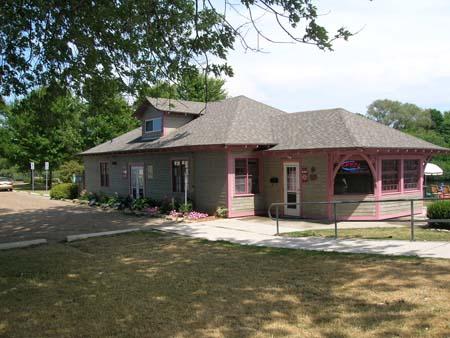
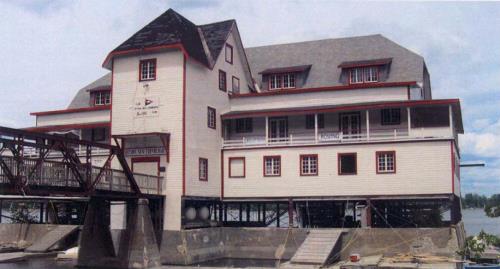
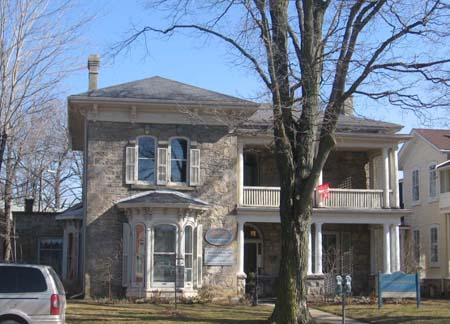
Featured is the west elevation of the Boat House.
Photo: Lyndsay Haggerty, 2007.
- Recognized
- 1997
- By
- Local government
The register’s text, word for word
Description
The Boat House is located at 116 Gordon Street, on the north side of Gordon Street between Wellington Street West and the Speed River and north of the Royal City Park, in the City of Guelph. The single-storey wood frame recreational facility was constructed in circa 1930.
The property was designated, by the City of Guelph, in 1997, for its historical or architectural value or interest, under Part IV of the Ontario Heritage Act (By-law 1997-15531).
Heritage value
The Boat House is situated on the west bank of the Speed River, a Canadian Heritage River and is in close proximity to another public recreation area, the Royal City Park. It has clear vistas to the Gordon Street Bridge (Dundas Bridge) which emphasizes the recreation facility's function and continued relationship to Guelph's water and associated recreational activities.
The Boat House is the last remaining boat house associated with early recreational activities in the City of Guelph's river systems. The property upon has continued to serve the citizens of Guelph in a capacity related to aquatic recreation for more than 130 years.
The property on which the Boat House is situated has a long association with the Speed River that dates back to the mid 1870s. Guelph's first boat house was built on the site in 1876. At that time, James Johnson managed a boat rental business from the boat house in partnership with a Guelph businessman. In 1885, James' brother William took over as manager. Under William's proprietorship, the Speed Canoe Club, one of the city's most active social and sporting organizations, was formed. The club recorded an impressive membership of 250 people between 1895 and 1900.
A second boat house was built to replace the 1876 boathouse in 1916 by William Johnson with the permission of the City's Parks and Shade Commission, who had purchased the property in 1910. The boat house standing today is thought to have been constructed in circa 1930, as either a new building or a renovation of the 1916 building.
The Boat House has had a number of public uses since that time, notably, as the Navy League for the duration of World War II and the Sea Cadets, until 1993. In 1997, it underwent major restoration to become a multi-use recreational facility, including an ice-cream parlour, river interpretive centre and a visitor information centre.
The Boat House, displaying Victorian features such as upturned eaves and wooden brackets, is believed to be the last example of historic Recreation or Pavilion architecture on the Speed River. Of wood frame construction, it has an overall low building mass which is representative of the Pavilion style of architecture, as well as a mixture of hip and gable rooflines. Dormer windows on the east and west elevations are unique features. Also of note are the original window and door openings on all elevations.
SourceCity of Guelph By-law 1997-15531; City of Guelph, History of Johnson's Boat House.
Character‑defining elements
Character defining elements that contribute to the heritage value of the Boat House include its:
- continued use as a venue for aquatic recreation for more than 130 years
- wood frame construction
- exposed original window and door openings
- hip and gable roofline
- upturned eaves
- wooden brackets
- dormer windows on the northwest and southeast elevations
- location on the west bank of the Speed River
- proximity to the Royal City Park
End of the register’s text
Location
116, Gordon Street, City of Guelph, Ontario, N1H, Canada
43.53975° N, 80.24307° W
Get directions (opens in a new tab)Being on the register doesn’t make a place open to visitors. Many are private homes or businesses; please view them from the street.

Loading map…
Similar places
Places whose register descriptions are closest to this one.
From the Canadian Register of Historic Places, as last updated on December 12, 2025. The register’s text is shown word for word.