Recognized Federal Heritage Building
Saint Anne’s Hospital-Administration Building
Senneville, Quebec
Also known as Administration Building
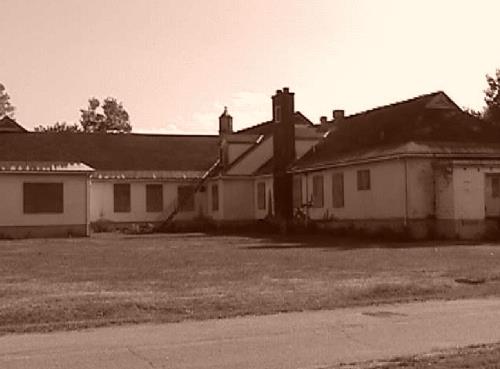
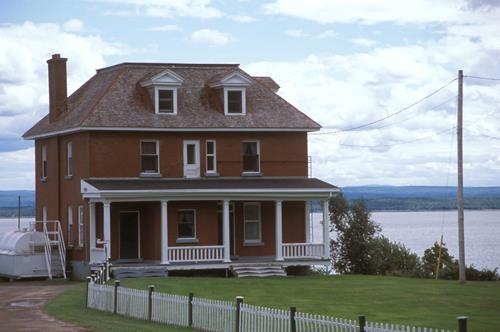
Administration Building of Saint Anne's Hospital, Foyer Senneville, constructed in 1946, north-west side
Photo: (Marc Lecavalier, Hôpital Sainte-Anne, Anciens Combattants Canada, 2001)
- Built
- 1946
- Recognized
- 2002
- By
- Government of Canada
The register’s text, word for word
Description
The Saint Anne’s Hospital-Administration Building consists of a one-and-a-half-storey central pavilion with a gable roof, and one-storey wings with hipped roofs that flank either side, and is located at the center of the Senneville Lodge. The designation is confined to the footprint of the building.
Heritage value
The Saint Anne’s Hospital-Administration Building is a Recognized Federal Heritage Building because of its historical associations, and its architectural and environmental values:
Historical value:
The Saint Anne’s Hospital-Administration Building is associated with the history of veterans in Canada, specifically their specialized medical care. The Saint Anne’s Hospital-Administration Building is one of several pavilions at the Senneville Lodge, a rehabilitation and convalescent centre for the seriously ill and wounded soldiers of the Second World War. An addition to Sainte Anne’s Hospital, Senneville Lodge was built during the 1946-1960 phase of expansion of the Village of Senneville and expanded the hospital’s mission from treating the war wounded to include the rehabilitation of veterans. The veterans developed close ties with the community and enjoyed all the local amenities which was considered an integral part of their return to civilian life.
Architectural value:
The Saint Anne’s Hospital-Administration Building is a good example of a classically inspired, hybrid style building, and is constructed of durable, good quality materials. The functional design of the Saint Anne’s Hospital-Administration Building is notable for accommodating a fairly complex program of spaces including the central canteen, administrative offices and medical clinic.
Environmental value:
The Saint Anne’s Hospital-Administration Building is located at the heart of the Senneville Lodge, which consists of a group of small pavilions in a natural country setting. The Saint Anne’s Hospital-Administration Building reinforces the character of the rural environment and is compatible with the large country estates and farms to the north and south of the property’s boundaries, as well as the residential architecture of the Village of Senneville. The Administration Building is a familiar landmark to the residents of the Village of Senneville.
Sources:
Geneviève Charrois, Three Buildings: Administration Building, Occupational Building and Treatment Building, Senneville Lodge, Pierrefonds-Senneville/Montréal, Québec District. Federal Heritage Buildings Review Office Building Report 01-074 (Part 2); Administration Building, Sainte Anne’s Hospital, Senneville, Québec, Heritage Character Statement 01-074.
Character‑defining elements
The character-defining elements of the Saint Anne’s Hospital-Administration Building should be respected.
Its distinctive, hybrid style, functional design, competent craftsmanship and good quality materials as manifested in:
-the horizontal composition and residential scale of the building which consists of a T-shaped plan with a one-and-a-half-storey central section covered by a low pitched gable roof, and one-storey flanking wings with low pitched hipped roofs;
-the incorporation of elements from the Palladian, Queen Anne and Classical styles as evidenced by the hip roof, wide overhanging eaves, cupola, wide dormers and central entrance vestibule with sidelights, fanlight and panelled door;
-the accommodation of a fairly complex program of spaces in a flexible plan wherein the entrance lobby leads to a double-loaded corridor formerly serving office spaces and also features a large space at the core of the building with adjacent specialized areas formerly housing food services; and,
-the use of durable, good quality materials for its construction such as concrete block with a rough cast finish.
The manner in which the Saint Anne’s Hospital-Administration Building reinforces the rural character of the setting as evidenced in:
-its central location at the heart of the Senneville Lodge surrounded by a turfgrass plane featuring mature trees;
-its relationship to the primary circulation system such as the access road which branches off in front of the building and encircles the complex;
-its compatibility with the architectural styles of the large country estates and farms to the north and south of the property’s boundaries as well as the residential architecture of the Village of Senneville;
-its close proximity to the Village of Senneville and familiarity to the residents of the village.
End of the register’s text
Location
55 Senneville Road, Senneville, Quebec, Canada
45.42000° N, 73.96000° W
Get directions (opens in a new tab)Being on the register doesn’t make a place open to visitors. Many are private homes or businesses; please view them from the street.

Loading map…
Nearby
 Maison Simon-Fraser1.8 km · Montréal
 Sainte-Anne-de-Bellevue Canal National Historic Site of Canada1.8 km · Sainte-Anne-de-Bellevue · 1840
 Senneville Historic District National Historic Site of Canada2.2 km · 1860
 Battle of the Lake of Two Mountains National Historic Site of Canada3.5 km · Montréal
 Maison Rangé-Dit-Laviolette4.5 km · Montréal
 Trestler House National Historic Site of Canada5.1 km · Vaudreuil-Dorion · 1798
Similar places
Places whose register descriptions are closest to this one.
 Staff Headquarters of the Royal 22 Regiment, former Hospital, Building 1Québec, Quebec
 Valcartier Forestry Research Station Administration BuildingSaint-Gabriel-de-Valcartier, Quebec
 Administration BuildingQuébec, Quebec
 Administration Building A1Stony Mountain, Manitoba
 Building 100Saint-Antoine-de-l'Isle-aux-Grues, Quebec
 Building 67Grosse-Île, Quebec
From the Canadian Register of Historic Places, as last updated on December 12, 2025. The register’s text is shown word for word.