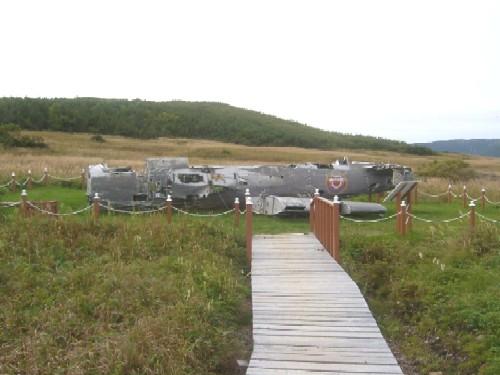
RCAF Liberator Bomber Crash Site
Also known as: RCAF Liberator Bomber Crash Site, Liberator EW127 Air Wreck Site
Description
This historic place consists of the remains of the forward section of Consolidated B-24 Liberator EW127 plane. The remains include nose landing gear, crumpled aluminum fuselage pieces and parts of the cockpit, which can be found on land and in shallow water in the vicinity of Sansum Point on Vancouver Island, B.C. The engines and bulk of the fuselage are missing and are thought to lie in deep water.
British Columbia's Heritage Conservation Act automatically protects all heritage wrecks, including the remains of all wrecked vessels and aircraft once two or more years have passed since the date of loss. It is illegal to damage, alter or remove a heritage object from a heritage wreck except under a permit issued by the Archaeology Branch.
Heritage Value
The Consolidated B-24 Liberator EW127, a four engine heavy bomber aircraft, crashed into the waters of Sansum Narrows between Salt Spring Island and Vancouver Island on October 4, 1944 while flying from Abbotsford on a routine night navigation exercise. The crash site of EW127 has cultural and historic value as a memorial site, and as an illustration of the types of aircraft used for training in World War II.
The crash site is valued as a memorial to the 11 crew members who died in the crash and to many others lost in training exercises with this type of aircraft. The EW127 belonged to the Royal Canadian Air Force's Western Air Command, Operational Transport Unit (OTU) No.5 based in Abbotsford and Boundary Bay. This was the unit's first Liberator fatality. Tragically, a total of 90 airmen (including those aboard EW127) from the Operational Transport Unit were killed in training accidents in the sixteen months following the crash of EW127.
The EW127 has historic value for being representative of the planes used to train commonwealth air crews during World War II. The Consolidated B-24 Liberator was an American four engine heavy bomber, designed by Consolidated Aircraft of San Diego, and flown by almost every allied air force in World War II. Between 1940 and 1945, 18,482 Liberators were built. EW127 was taken on by Western Air Command May 20, 1944 and lost 5 months later.
The crash site of Liberator EW127 also has historic value as a symbol of Canada's role in training Allied air crews during World War II through the British Commonwealth Air Training Plan. The crash site is a reminder that the Royal Canadian Air Force operated Liberators in anti-submarine squadrons, in heavy transport, and in Operational Transport Units during World War II.
Character-Defining Elements
The key elements that define the heritage character of Liberator EW127 include:
- The extant wreckage in the forest and in shallow water at Sansum Point which consists of a nose wheel assembly, broken windscreen and instrumentation panel, and crumpled aluminum fuselage pieces
- A 50 calibre machine gun barrel, found in a tree at the site and donated to the British Columbia Aviation Museum in Sidney, B.C.
Gallery
3 imagesLocation
Loading map...
Similar Places
Heritage sites with similar characteristics