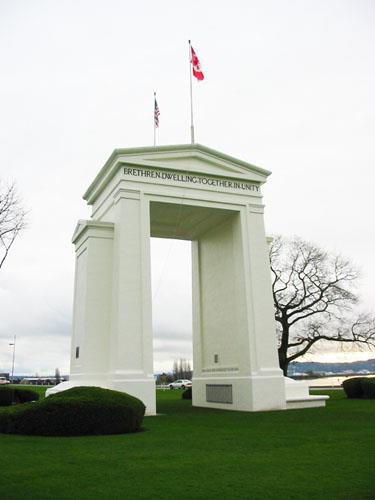
Peace Arch Monument
Photo: Ministry of Environment, BC Parks
- Built
- 1921
- Recognized
- 1939
- By
- Province of British Columbia
The register’s text, word for word
Description
The Peace Arch is the monumental concrete arch that straddles the Canada-United States border between the northbound and southbound roadways in the Central Lawn of Peace Arch Provincial Park, located in Surrey, British Columbia.
Heritage value
The Peace Arch is of social, cultural, and aesthetic significance, and particularly of symbolic importance, with its public message of kinship and shared ideals between the two countries.
The arch is of social value as an enduring monument known to successive generations as a thing of beauty and consequence. It is culturally significant because it represents a time when each country felt a willingness to publicly express their shared sense of friendship and openness toward the other.
The aesthetics are important for having a distinctly American character, showing elements common to institutional buildings and monuments found in that country. The American character of the Classical Revival design conveys the history of the impetus for the construction of the monument: Samuel Hill, citizen of Seattle, was the driving force behind the Good Roads Association of Washington State, and the building of the arch. The design is significant for being the work not of an American, but of the London architect H.W. Corbett, who was commissioned by Hill to design the arch on a pile foundation that was thought to be very forward-thinking in its ability to withstand the shock of an earthquake.
Currently listed on the United States National Register of Historic places, the Peace Arch has spurred advocacy groups on both sides of the border for its importance as a symbol of peace; a 75th anniversary group formed in 1995 has continued to work towards the protection and conservation of the Peace Arch.
The monument makes plain the lasting peaceful ties between the countries, by dissolving the borderline in its immediate environs. Its cross-border accessible and permeable nature embodies the openness expressed in the inscription on the Canadian side: "BRETHREN DWELLING TOGETHER IN UNITY".
SourceMinistry of Environment, BC Parks
Character‑defining elements
Key elements that define the heritage character of the Peace Arch include its:
Site:
-unfenced Central Lawn surrounding the monument
-siting that straddles the two countries
-siting between north-bound and south-bound roadways
-expansive views across lawns and out to sea
Monument:
-simple massive structure
-monochromatic colouring
-open lawn under arched opening
-American character in form and details
-pediment
-flagpoles and flags of the two nations
-frieze with inspirational inscription
-inscriptions chiselled into the concrete on the plinth above the pedestals: "Children of a Common Mother" on the American side, and "Brethren Dwelling Together in Unity" on the Canadian side
-dedication plaques
-precious artifacts from the Mayflower and S.S. Beaver behind bronze plaques on interior faces of the arch
-bronze gates on interior faces of the arch over which are placed two inscriptions: "1814 Open for One Hundred Years 1914" and "May these gates never be closed"
End of the register’s text
Location
16855 Peace Park Drive, Surrey, British Columbia, Canada
49.00212° N, 122.75649° W
Get directions (opens in a new tab)Being on the register doesn’t make a place open to visitors. Many are private homes or businesses; please view them from the street.

Loading map…
Nearby
All 82 places in Surrey
Similar places
Places whose register descriptions are closest to this one.
From the Canadian Register of Historic Places, as last updated on December 12, 2025. The register’s text is shown word for word.