Classified Federal Heritage Building
Louis S. St-Laurent Building, Old Post Office
Québec, Quebec
Also known as Old Post Office, Ancien bureau de poste, Federal Building
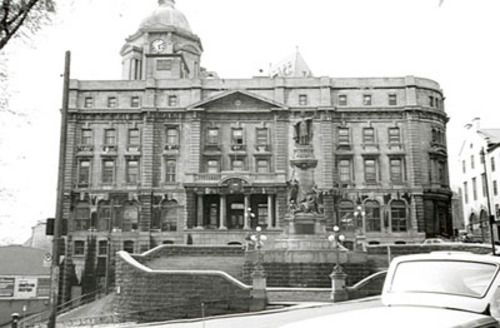
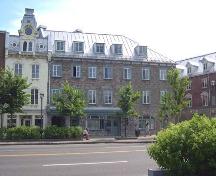
General view of the Louis S. St-Laurent Building, 1983.
Photo: Agence Parcs Canada / Parks Canada Agency, 1983.
- Built
- 1872–1873
- Recognized
- 1983
- By
- Government of Canada
The register’s text, word for word
Description
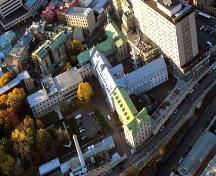
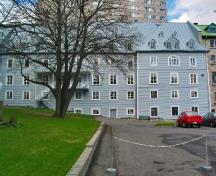
The Louis S. St-Laurent Building is located in the urban setting of Quebec’s City’s Upper Town. It is an impressive three-and-a-half storey, corner building designed elaborately in the Second Empire style, with later Beaux-Arts design elements. Clad in cut stone, its symmetrical façades are embellished with a rich classical vocabulary and ornamentation, culminating in an attic storey. The designation is confined to the footprint of the building.
Heritage value
Louis S. St-Laurent Building is a Classified Federal Heritage Building because of its historical associations, and its architectural and environmental values.
Historical Value
Much of the value of the building lies in its historical associations. The construction of the original building marked an important stage in the development of an international postal communication network, and the Louis S. St-Laurent Building is one of the few postal facilities, to survive from this period.
Architectural Value
The Louis S. St-Laurent Building is valued for its very good aesthetic quality and functional design. It represents an early and important use in Canada of the Second Empire Style, which subsequently became somewhat obscured with the reworking and expansion of the building, which took place between 1913 and 1919. The resulting complex reflected the more classically-inspired and grandiose approach of the Beaux Arts style popular at the time of the later modifications.
Environmental Value
Louis S. St-Laurent Building reinforces the historic character of its urban setting. Recent redevelopment work has further modified some of the exterior detailing, but overall the building remains an architecturally significant and dominant element in the important urban setting of Quebec's Upper Town.
SourceNathalie Clerk & Marc De Caraffe, Louis S. St-Laurent Building, Old Post Office, Quebec City, Quebec, Federal Heritage Building Review Office Building Report 82-010; Louis S. St-Laurent Building, Old Post Office, Quebec City, Quebec, Heritage Character Statement, 82-010
Character‑defining elements
The following character-defining elements of Louis S. St-Laurent Building should be respected.
Its very good aesthetic and functional design and good craftsmanship and materials, for example:
— its three-and-a-half storey, L-shaped massing clad in carved ashlar limestone;
— the remaining Second Empire style elements, including the projecting pilasters, the classical ornamentation, including the columns, entablature and voussoirs;
— the Beaux-Arts style elements added during the 1913-1919 modifications, including the sympathetic stone attic storey completed in the same design vocabulary as the original building, the flat roof, the monumental entrance preceded by a portico topped by a pediment and the dome that crowns the building;
— the extension added to the main building in 1913-1919.
The manner in which the Louis S. St-Laurent Building reinforces the historic character of its urban setting and is a landmark in the region, as evidenced by:
— its importance as a marker for a significant stage in the development of an international postal communication network and as a rare example of a post office from this period;
— its style and its importance as a local landmark, which makes it an architecturally significant and dominant element in the urban setting of Quebec's Upper Town.
End of the register’s text
Location
3, Passage du chien d'or, Québec, Quebec, Canada
46.81800° N, 71.21300° W
Get directions (opens in a new tab)Being on the register doesn’t make a place open to visitors. Many are private homes or businesses; please view them from the street.

Loading map…
Nearby
All 194 places in Québec
Similar places
Places whose register descriptions are closest to this one.
From the Canadian Register of Historic Places, as last updated on December 12, 2025. The register’s text is shown word for word.