Recognized Federal Heritage Building
Lighttower
Gull Island, Newfoundland and Labrador
Also known as Gull Island Lighttower, Phare de l'île Gull
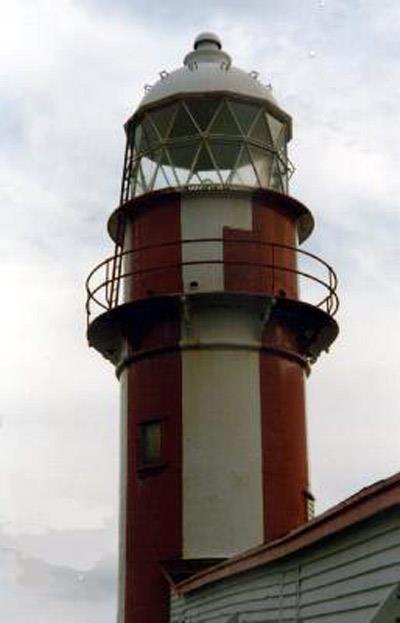
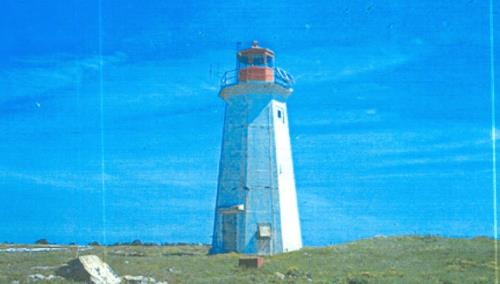
Gull Island Lighttower Recognized Federal Heritage Building
Photo: Pêches et Océans Canada - Fisheries and Oceans Canada (1992).
- Built
- 1884
- Recognized
- 1989
- By
- Government of Canada
The register’s text, word for word
Description
The Lighttower on Gull Island is a straight, unadorned, prefabricated cast iron cylinder, 11.6 meters in height. Its shaft, founded directly on bedrock, is punctuated by two small windows and a corbelled gallery with a simple balustrade. It is topped by a circular lantern with two tiers of triangular glazing, a small dome and ventilator. The structure is painted in alternating red and white vertical bands and linked to the lightkeeper’s house by a covered walkway. The lighttower is part of a small lightstation complex, located on a remote island off Newfoundland’s north coast. The designation is confined to the footprint of the structure.
Heritage value
The Lighttower on Gull Island is a Recognized Federal Heritage Building because of its historical associations, and its architectural and environmental values.
Historical value:
The Lighttower on Gull Island is associated with the development of safe navigation in pre-Confederation Newfoundland. Considered to be a minor navigational light, it coincided with the rise of fishery in the Grand Bank waters and still serves locals in shipping and fishing.
Architectural value:
The Lighttower on Gull Island is a well-proportioned structure and an excellent example of the standardized prefabricated cast iron component structures. It is an example of technological advancement in tower construction, which moved away from fire-prone timber structures. Shipped from England and assembled on-site, a process common for late 19th Century Newfoundland, this design had the functional advantages of low costs, easy shipment and rapid assembly.
Environmental value:
The Lighttower on Gull Island reinforces the rugged and utilitarian character of its setting, a remote, barren and rocky island off Newfoundland’s north coast, which it shares with other light station buildings.
Sources:
Sally Coutts, Gull Island Lighthouse, Gull Island, Newfoundland. Federal Heritage Buildings Review Office Report 88-133; Gull Island Lighthouse, Gull Island, Newfoundland, Heritage Character Statement 88-133.
Character‑defining elements
The character-defining elements of the Lighttower on Gull Island should be respected.
Its simple, efficient design and standardized construction, as demonstrated in:
-the overall distinctive form and simplified lines of the structure’s exterior;
-the prefabricated cast iron cylindrical shaft, with its two small window openings and an exterior gallery supported on iron fretwork brackets above a fledging cornice;
-the protective paint daymarks, which consist of six alternating red and white vertical bands and contribute to its visibility;
-the prefabricated cast iron lantern, with its circular light composed of two tiers of triangular glazing, topped by a small dome and ventilator.
The manner in which the building reinforces the rugged and utilitarian character of its setting:
-the structure’s open relationship to the rugged and barren site and to the other buildings of the light station;
-the physical link to the lightkeeper’s house by a covered walkway, which testifies to the Island’s rugged conditions.
End of the register’s text
Location
Gull Island, Newfoundland and Labrador, Canada
49.99833° N, 55.35916° W
Get directions (opens in a new tab)Being on the register doesn’t make a place open to visitors. Many are private homes or businesses; please view them from the street.

Loading map…
Similar places
Places whose register descriptions are closest to this one.
From the Canadian Register of Historic Places, as last updated on December 12, 2025. The register’s text is shown word for word.