Recognized Federal Heritage Building
Light Tower (Rear)
Lachine, Quebec
Also known as Lachine Light Tower - Rear Range, Phare de Lachine - feu de direction arrière
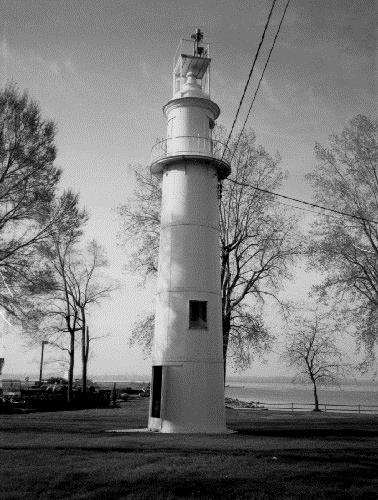
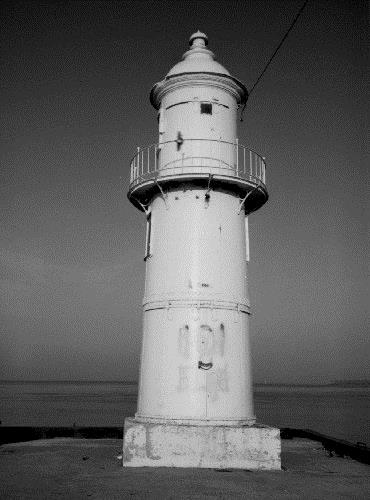
General view of the Light Tower (Rear), showing the tapered massing composed of a concrete base, four cylindrical sections and the attractive metal cupola which houses the light apparatus, 1989.
Photo: Canadian Coast Guard / Garde côtière canadienne, 1989.
- Built
- 1900
- Recognized
- 1991
- By
- Government of Canada
The register’s text, word for word
Description
The Light Tower (Rear) is one of two identically designed towers in St. Louis Park, a municipal recreation space on the waterfront. Taller than its twin, the rear range tower is located in a grassy area of the park. It is a white-painted metal, tapered tower of slim proportions, set on a concrete base. An attractive, decorative metal cupola houses the light apparatus and is accessed by a circular, metal gallery platform accented by corbels. An additional small equipment platform crowns the tower. The designation is confined to the footprint of the building.
Heritage value
The Light Tower is a Recognized Federal Heritage Building because of its historical associations, and its architectural and environmental value.
Historical Value
The Light Tower is associated with the establishment of major industries in Lachine, which were attracted by the proximity of maritime and rail transportation corridors.
Architectural Value
The Light Tower is valued for its good aesthetic and very good functional design. It has elegant proportions and is an extremely rare example of a circular metal tower outside of Newfoundland. One of two matching towers at the site, it was built using the metal-working techniques developed in the early part of the 20th century for shipbuilding and boiler-making. The techniques consist of assembling slightly curved steel plates and fastening them with rivets to form a truncated cone. Steel was used because it was resistant and easy to maintain, provided it was properly protected against corrosion.
Environmental Value
The Light Tower reinforces the maritime character of its recreational setting at St. Louis Park. It is a well-known landmark in the region.
SourceJoan Mattie, Québec, Federal Heritage Buildings Review Office, Building Report, 89-172; Lachine Lighthouse, Bicquette Island, Québec, Heritage Character Statement, 87-088.
Character‑defining elements
The character-defining elements of the Light Tower should be respected.
Its good aesthetic and very good functional design, and good craftsmanship and materials, as for example:
- the tapered massing composed of a concrete base, four cylindrical sections, an attractive metal cupola which houses the light apparatus and the additional small equipment platform;
- the metal construction and components;
- the circular gallery platform and railing supported by corbels;
- the sliding door system;
- the two lateral openings.
The manner in which the Light Tower reinforces the maritime character of its recreational setting and is a well-known landmark in the region, as evidenced by:
- its overall design and materials, which harmonize with its park and waterfront surroundings;
- its role as a landmark to pleasure boaters and Canadian Coast Guard vessels;
- its visibility and familiarity to tourists and residents of the region, due to its prominent location on a grassy picnic area of a popular municipal recreation park.
End of the register’s text
Location
Lachine, Quebec, Canada
45.44460° N, 73.63742° W
Get directions (opens in a new tab)Being on the register doesn’t make a place open to visitors. Many are private homes or businesses; please view them from the street.

Loading map…
Nearby
All 4 places in Lachine Ancien hôtel de ville2.7 km · Montréal
 Moulin à vent Fleming2.7 km · Montréal · 1827
- Site archéologique de l'Église-des-Saints-Anges-de-Lachine2.7 km · Montréal
 Site historique et archéologique Le Ber-Le Moyne2.8 km · Montréal
 9601, boulevard LaSalle2.8 km · Montréal · 1930
 Maison De Lorimier-Bélanger2.8 km · Montréal · 1775
Similar places
Places whose register descriptions are closest to this one.
From the Canadian Register of Historic Places, as last updated on December 12, 2025. The register’s text is shown word for word.