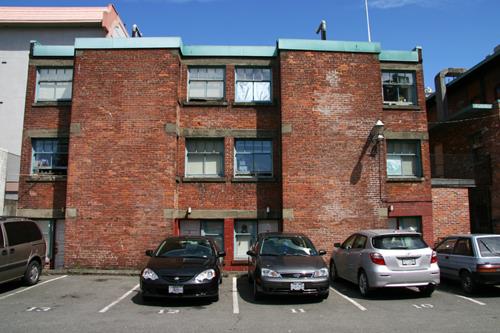
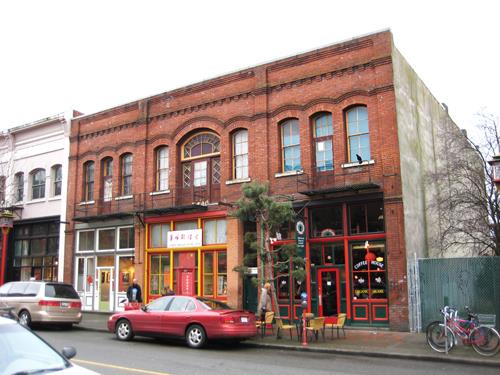
Kong Sin Wing Rooming House
Photo: City of Victoria, 2008
- Built
- 1913
- Recognized
- 1991
- By
- Local government
The register’s text, word for word
Description
The Kong Sin Wing Rooming House is a three-storey brick tenement that occupies the rear of a mid-block lot on Fisgard Street on the periphery of Victoria's Chinatown. The tenement is accessed through a narrow passageway that penetrates the façade of the Gee Tuck Tong Benevolent Association Building at 622-626 Fisgard Street.
Heritage value
The Kong Sin Wing Rooming House, built in 1913, is valued as part of a grouping of early buildings that contribute to the historic character and urban pattern of Victoria's Chinatown, the seminal and most intact Chinatown in Canada. Victoria was the primary point of entry for Chinese into Canada until the early twentieth century.
This building is valued as a representative example of Victoria’s Chinatown tenement housing and typifies the Chinese custom of living in close proximity in a tight-knit community. It was built for Kong Sin Wing in 1913 in the courtyard space behind the Gee Tuck Tong Benevolent Association at 622-626 Fisgard Street. Its hidden location is expressive of a duality in architecture and cultural landscape. On each block of Chinatown, street façades link together, forming a wall that shields interior spaces and narrow alleyways between and through buildings are linked to central courtyards which were the hidden location of tenements, opium dens, theatres and gambling houses. This configuration allowed the Chinese community to adhere to follow traditional religion, kinship and economic practices while projecting the image of assimilation to Western society. This building, not to be viewed by the non-Chinese community, lacks the embellishment visible on more public façades. Additionally, it is an excellent example of an internal space that is only accessible through a series of passageways.
This building is also significant as a surviving design by architects Percy Fox and Ralph Berrill. Fox (1877-1939) came to Victoria from England in 1911 and two years later began a partnership with fellow Englishman, Ralph Berrill (1880-1955). This tenement is one of their earliest works. Both men interrupted their careers to serve in the First World War. On return, they worked together until 1921, when each began a separate career.
SourceCity of Victoria Planning Department
Character‑defining elements
Key elements that define the heritage character of the Kong Sin Wing Rooming House include its:
- location north of Fisgard Street, behind the Gee Tuck Tong Benevolent Association Building and barely visible from the street, accessed by a narrow passageway; part of a grouping of late-nineteenth and early-twentieth century historic masonry buildings in Victoria's Chinatown
- continuous residential use
- residential form, scale and massing, as expressed by its three-storey height, cubic massing with articulated square bays, and flat roof
- masonry construction, including red-brick walls and concrete sills
- typical Chinese tenement block features, such as access from a narrow passageway, internal courtyard and individual entry doors leading off common exterior hallways
- regular fenestration, including one-over-one and four-over-two double-hung wooden-sash windows with horns
- sidewall chimneys, indicating residential occupation
End of the register’s text
Location
624 1/2 Fisgard Street, Victoria, British Columbia, Canada
48.42973° N, 123.36603° W
Get directions (opens in a new tab)Being on the register doesn’t make a place open to visitors. Many are private homes or businesses; please view them from the street.

Loading map…
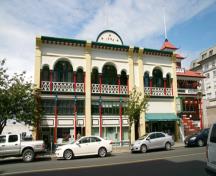 Gee Tuck Tong Benevolent Association Buildingwithin 100 m · 1903
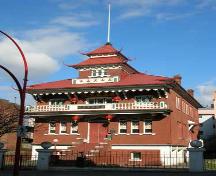 Chinese Consolidated Benevolent Association and Chinese Public Schoolwithin 100 m · 1909
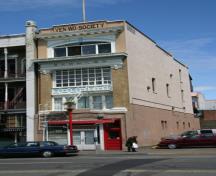 Yen Wo Society Buildingwithin 100 m · 1912
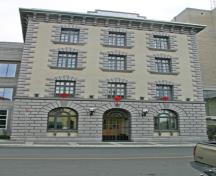 City of Victoria Police Stationwithin 100 m · 1914
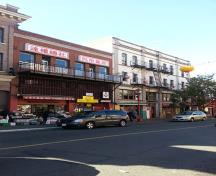 Victoria Chinatownwithin 100 m
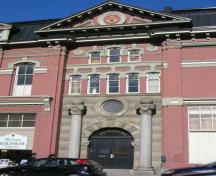 Masonic Templewithin 100 m · 1878
Similar places
Places whose register descriptions are closest to this one.
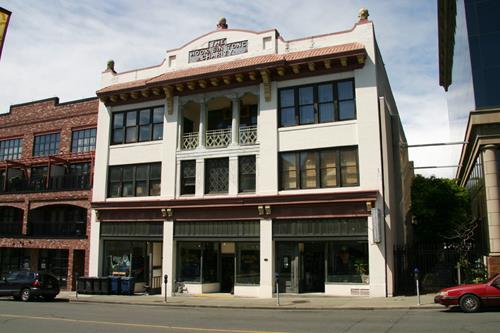
From the Canadian Register of Historic Places, as last updated on December 12, 2025. The register’s text is shown word for word.