City of St. John's Heritage Building, Structure, Land or Area
King George V Building
St. John's, Newfoundland and Labrador
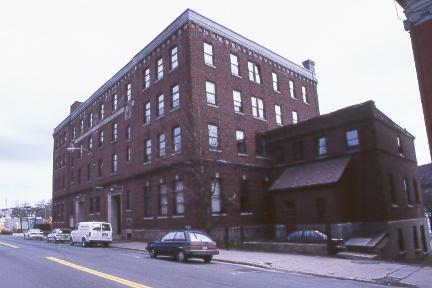
View of front facade and right side, King George V Building, 93 Water Street, St. John's.
Photo: HFNL 2005
- Built
- 1911–1912
- Recognized
- 1989
- By
- City of St. John's
The register’s text, word for word
Description
The King George V Institute is a four storey neoclassical rectangular building It is located on Water Street East diagonally across the street from the Newfoundland National War Memorial. The designation is confined to the footprint of the building.
Heritage value
The King George V Building has been designated as a municipal heritage building because of its historical, aesthetic and cultural values.
This building is significant because of its association with the life, work, and cultural contributions of the medical missionary Sir Wilfred Thomason Grenfell, one of Newfoundland and Labrador's great cultural heroes.
The building is historically important because of its long historical associations with the military and maritime history of Newfoundland and Labrador. It was originally constructed for the welfare of seamen and working outport girls, a hostel for the crews of allied warships and merchant ships, and was known as the Caribou Hut, after the emblem of the Royal Newfoundland Regiment.
Aesthetically, the King George V Building is a noteworthy example of the neo-classical public buildings designed by the American architectural partnership of Williams Adams Delano and Chester H. Aldrich. The building is constructed with the typical Delano and Aldrich materials of brick and limestone, and the clarity and simplicity of the design is representative of the firm's work.
The King George V Building has great cultural value to community and to the province of Newfoundland and Labrador, associated as it is with the public works of the Grenfell Mission. The building has a great deal of local sentimental value, and serves as an unofficial memorial to the great sealing disaster of 1914. Following the disaster, the frozen bodies of dead sealers from S.S. Newfoundland were thawed in vats of hot water in the basement of the building.
An important historical side note of the place is that the cornerstone of the building was laid, on land donated by Sir Edgar Rennie Bowring, by King George V on his coronation day, June 22, 1911, through the agency of an electronic current from Buckingham Palace with Governor Sir Ralph Williams completing the laying of the stone on His Majesty's behalf. At the time, it was believed to be the first laying of a cornerstone anywhere in the world by remote control.
SourceHeritage Foundation of Newfoundland and Labrador property file #1500 St. John's - King George V Institute.
Character‑defining elements
All elements related to the establishment of the King George V Institute, including:
- original paired entrance doors, originally used as male and female
entrances;
- original stone banding reading "KING GEORGE THE FIFTH INSTITUTE";
- all historical stone and bronze tablets and plaques (interior and
exterior) with inscriptions marking the contributions of the Grenfell
Mission and the Bowring family; and,
- the original foundation stone laid by King George V by remote control from Buckingham Palace.
All elements related to the construction and neo-classical design of the building by the firm of Delano and Aldrich, including:
- masonry foundation, brick walls, and stone detailing;
- stone detailing around and surmounting the main entranceways;
- brick course detailing at the top of the first storey on main facade;
- brick and stone entablature/cornice at the roofline on main facade;
- original stone banding and carved medallions between third and fourth storeys on the main facade;
- original cast iron fencing along the public sidewalk on the northwest corner of the property;
- those interior features (staircases, mantel pieces, etc) which are
reflective of the original neo-classical design of the building;
- window size, style, and placement; and
- building height, massing and general dimensions.
End of the register’s text
Location
St. John's, Newfoundland and Labrador, A1C, Canada
47.56688° N, 52.70364° W
Get directions (opens in a new tab)Being on the register doesn’t make a place open to visitors. Many are private homes or businesses; please view them from the street.

Loading map…
 Crow's Nest Officer's Clubwithin 100 m · 1892
 S.O. Steele Buildingwithin 100 m · 1894
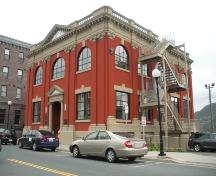 Commercial Cable Company Building Registered Heritage Structurewithin 100 m · 1915
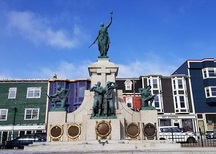 Newfoundland National War Memorial National Historic Site of Canadawithin 100 m · across from Harbourside Park · 1923
 Tobin Buildingwithin 100 m · 1894
 EnhancedTobin Building Municipal Heritage Buildingwithin 100 m · 1894
Similar places
Places whose register descriptions are closest to this one.
 St. George Government of Canada BuildingSt George, New Brunswick
 Government of Canada BuildingSaint George, New Brunswick
 Grenfell HouseSt. Anthony, Newfoundland And Labrador
 Queen Victoria WingSt. John's, Newfoundland And Labrador
 Hon. George E. King ResidenceSaint John, New Brunswick
 Prince George HotelKingston, Ontario
From the Canadian Register of Historic Places, as last updated on December 12, 2025. The register’s text is shown word for word.