Heritage Designation
Hotel Stanley
Vancouver, British Columbia
Also known as Russ Hotel, Beaver Hotel, Iroquois Hotel
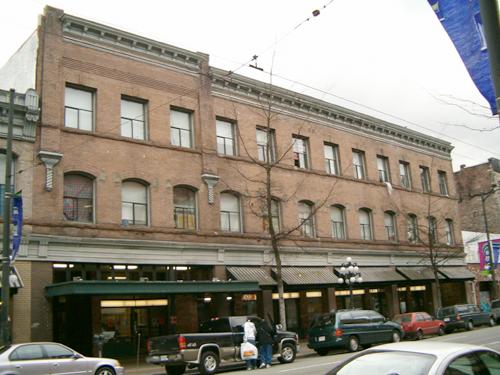
Exterior view of the Hotel Stanley
Photo: City of Vancouver 2004
- Built
- 1906
- Recognized
- 2003
- By
- City of Vancouver
The register’s text, word for word
Description
The Hotel Stanley is a three storey plus lower level Edwardian era masonry hotel building, located on the north side of West Cordova Street in the historic district of Gastown. Despite its unified appearance, the structure originally housed two separate but adjoining hotels. The ancillary space behind the hotel was developed in 1971 as a public courtyard, officially named Blood Alley in 1972.
Heritage value
Gastown is the historic core of Vancouver, and is the city's earliest, most historic area of commercial buildings and warehouses. The Hotel Stanley is valued as an early Gastown hotel, representative of the area's seasonal population in the early twentieth century, as Vancouver emerged as western Canada's predominant commercial centre. It was built as part of the investment portfolio of Evans, Coleman and Evans, general merchants and shipping agents, considered at the time one of the leading commercial firms in the province. Hotels such as this provided both short and long-term lodging, serving primarily those who worked in the seasonal resource trades such as fishing and logging. Many of these hotels had combined functions of commercial services on the ground floor and lodging rooms on the upper floors, which contributed to the lively street life in Gastown. Designed by architects Grant and Henderson in 1906, the Stanley was developed as two adjoining hotels run by separate proprietors. Additionally, it illustrates the rapid construction of a number of hotels along Cordova Street at this time, in response to a change in liquor licensing laws that abolished free-standing saloons on July 1, 1906.
The Hotel Stanley is valued for its architecture as an example of commercial design of the early twentieth century, illustrating how popular architectural styles were used by the hotel business to market a progressive image. It is also valued for its role in the revitalization of Gastown during the 1970s. The Stanley and the adjacent New Fountain Hotel were renovated in a project that combined commercial activity with the city's first privately developed rent-controlled housing.
SourceCity of Vancouver, Heritage Planning Street Files
Character‑defining elements
The character-defining elements of the Hotel Stanley include:
- location, in close proximity to the waterfront of Burrard Inlet and the Canadian Pacific Railway yard
- three storey, rectangular plan flat roofed form with lower level exposed at rear, with raised bay at western end
- spatial relationship to other late Victorian and Edwardian era commercial buildings
- siting on the property lines, with no setbacks at the front or side, and large open space at rear
- masonry construction: tan brick front facade with continuous rough-dressed sandstone stringcourses; and common red brick side and rear walls
- projecting sheet metal cornices at the storefront and parapet levels
- raised western bay on front facade with hanging pilasters with drop sheet metal brackets with rope design, and corbelled brick detail
- front facade fenestration: segmental arched window openings at the second floor level with sandstone corner blocks and rectangular window openings on third floor with brick voussoirs
- rear facade fenestration: segmental arched window openings with sandstone sills, with double-hung 2-over-2 wood-sash windows
- projecting sheet metal cornice at the parapet with repetitive smaller brackets, and a continuous sheet metal cornice above storefront
End of the register’s text
Location
36 Blood Alley Square, Vancouver, British Columbia, V6B, Canada
49.28283° N, 123.10514° W
Get directions (opens in a new tab)Being on the register doesn’t make a place open to visitors. Many are private homes or businesses; please view them from the street.

Loading map…

Similar places
Places whose register descriptions are closest to this one.
From the Canadian Register of Historic Places, as last updated on December 12, 2025. The register’s text is shown word for word.