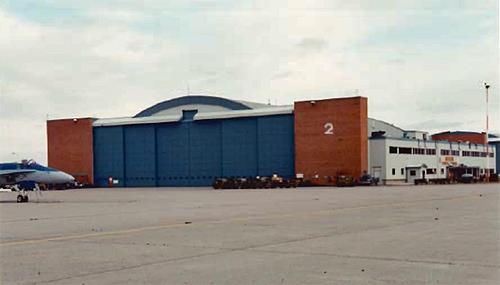
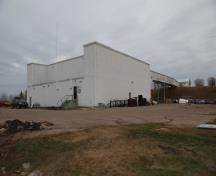
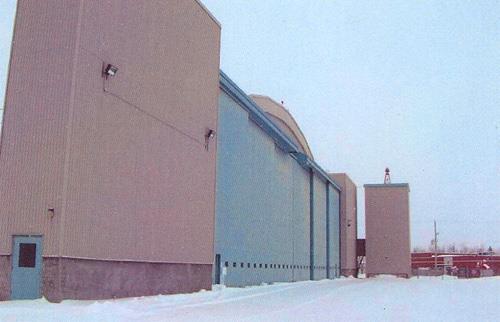
General view of Hangar 2 demonstrating the high, wide doorways that span its east and west elevations, the raised central sections for particularly high aircraft, and the brick pylons at each end, 2000.
Photo: Department of National Defence / Ministère de la Défense nationale, 2000.
- Built
- 1953
- Recognized
- 2001
- By
- Government of Canada
The register’s text, word for word
Description
Located at Canadian Forces Base Cold Lake, Aircraft Hangar No.2 is an economical structure of impressive scale and dynamic form. One of four identical hangars arranged along the runway, its distinguishing features are its curved roof and wide doorways. The designation is confined to the footprint of the building.
Heritage value
Heritage Value
The Aircraft Hangar No.2 is a Recognized Federal Heritage Building because of its historical associations, and its architectural and environmental value.
Historical Value
The Aircraft Hangar No.2 is a very good example of the theme Canada’s National Defence and the commitment of the Canadian government, in the 1950s, to international military preparedness. It was constructed as one of the 21 original buildings of the base, which was designed and operated as an independent community until 1996, when it became part of the municipality of Cold Lake.
Architectural Value
Aircraft Hangar No.2 is a very good example of a functional building designed according to a standard plan. It reflects The Department of National Defence’s preference, in the early 1950s for, functional, economical and conservative designs. It is similar in size and design to the base’s other four hangars, which is about half the size of the larger Hangar 1 on the base. It demonstrates good-quality workmanship and appropriate use of materials.
The Environmental Value
Aircraft Hangar No. 2, is located along the northeast-heading runway of the base’s L-shaped arrangement of runways. It is an integral part of the high-security aircraft zone and enjoys comfortable spatial and visual relationships with the other hangar, the runways and the base. It reinforces the present character of its post-war military training base setting.
Sources:
Aircraft Hangar No.2, Cold Lake, Alberta, Heritage Character Statement, 00-07.
Character‑defining elements
The following character defining elements of Aircraft Hangar No.2 should be respected, for example:
Its functional, economical design and high quality construction such as:
-Its impressive scale, and its dynamic form, dominated by its gently curved roof.
-Its high, wide doorways that span its east and west elevations, the raised central sections for particularly high aircraft, and the brick pylons at each end.
-Its arrangement of windows and doors on its north and south elevations.
-Its interior structure and finishes of its hangar space: the exposed bowstring truss system, the wood roof deck, the reinforced concrete slab floor, the windows and balconies of the adjacent offices and service spaces.
-Its interior layout, which clearly distinguishes between its two related functions.
The manner in which the Aircraft Hangar No.2 maintains a spatial relationship with the runways, the other hangars and the rest of the base, and reinforces the visual military character of its base setting within the community.
End of the register’s text
Location
4 Wing Cold Lake, Cold Lake, Alberta, Canada
54.41300° N, 110.27401° W
Get directions (opens in a new tab)Being on the register doesn’t make a place open to visitors. Many are private homes or businesses; please view them from the street.

Loading map…

Similar places
Places whose register descriptions are closest to this one.
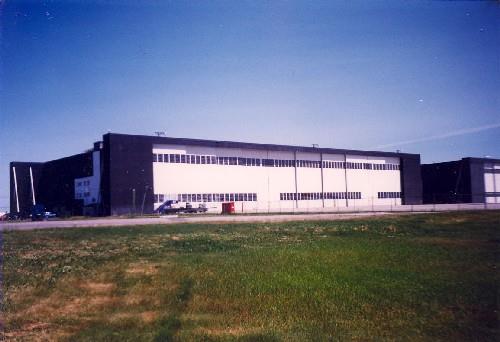 Royal Canadian Air Force Hangar 8Happy Valley-Goose Bay, Newfoundland And Labrador
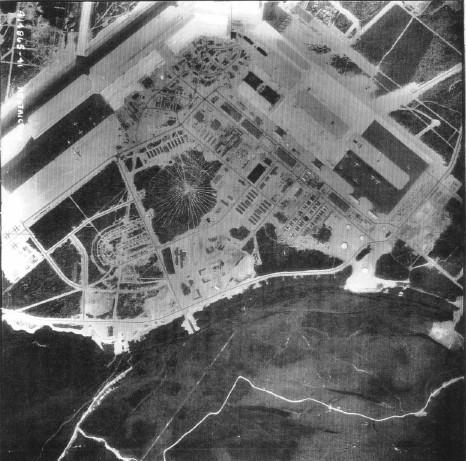 Royal Canadian Air Force Hangar 7Canadian Forces Base Goose Bay / Base des Forces canadiennes Goose Bay, Newfoundland And Labrador
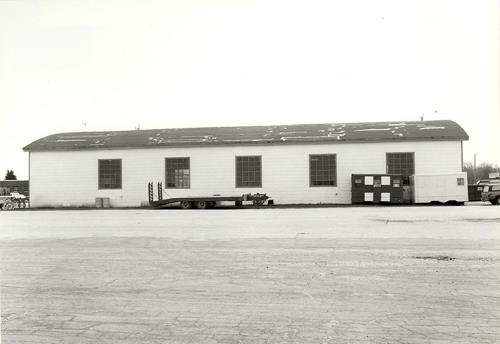 Hangar 6 at Hangar LineCanadian Forces Base Borden / base des Forces canadiennes Borden, Ontario
 Hangar 6La Baie, Quebec
 Hangar 3 at Hangar LineBorden, Ontario
 HangarHall Beach, Nunavut
From the Canadian Register of Historic Places, as last updated on December 12, 2025. The register’s text is shown word for word.