Heritage Lighthouse
Green Island (Catalina) Lighthouse
Catalina, Newfoundland and Labrador
Also known as Catalina Lighthouse, Phare de Catalina
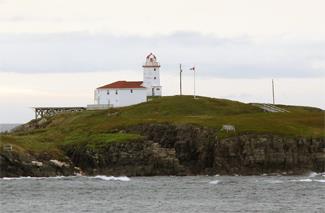
General view of Green Island (Catalina) Lighthouse, 2009.
Photo: Kraig Anderson - lighthousefriends.com
- Built
- 1856–1857
- Recognized
- 2015
- By
- Government of Canada
The register’s text, word for word
Description
Green Island Lighthouse is a 10.4 metres (34 feet) tall octagonal, tapered, reinforced concrete-clad stone lighthouse. The lighthouse is also known as Catalina Lighthouse. It stands off the east coast of Newfoundland, on a wave-swept island on the southern approach to Catalina Harbour in Trinity Bay.
There are four related building on the site that contribute to the heritage character of the lighthouse:(1) the 2003 dwelling/office; (2) the 1968 equipment building; (3) the 1968 storage building; and, (4) the winch house.
Heritage value
The Green Island Lighthouse is a heritage lighthouse because of its historical, architectural, and community values.
Historical values
The Green Island Lighthouse is an excellent example of the development of the system of aids to navigation in early colonial Newfoundland. The Green Island lightstation functions as a warning against the dangers of Flower Rocks, and guides vessels to safety as they enter Trinity Bay. Green Island Lighthouse is the oldest lighthouse erected after Newfoundland received full colonial status that is still standing. The lighthouse is associated with Newfoundland’s world famous fishing industry and with general trade with St. John’s.
The Green Island Lighthouse is an excellent example of the socio-economic growth of the region. Green Island is situated off the northeast coast of Newfoundland where shipping has been primarily regional and tied to Newfoundland’s world famous fishing industry, as well as sealing, whaling, and general trade with the capital city of St. John’s. The lighthouse has historically been associated with the community of Catalina, which was the only community on the shores of Trinity Bay in the mid-19th century. Green Island Lighthouse also enabled Port Union, the only union-built town in North America, to become a vibrant international port and a thriving commercial and industrial centre.
Architectural values
The Green Island Lighthouse is a very good quality lighthouse design. Though originally the lighthouse suffered due to unsuitable materials and construction techniques, it has since undergone multiple changes and repairs. The lighthouse became a sturdy structure that has remained standing and functional. It is an example of early experiments to find appropriate functional types and materials capable of withstanding Newfoundland’s severe climate.
Community values
Located in a spectacular setting that is dominated by the natural marine environment of wave-swept rugged cliffs, the Green Island Lighthouse reinforces the maritime character of the area. The size of the lighthouse makes it the most prominent structure at the lightstation. The lighthouse and its surrounding secondary buildings form a picturesque grouping.
The Green Island Lighthouse is highly valued by the local community. Accessible by boat or plane, it figures daily into the lives of the locals. It is a major landmark for local mariners, passing commercial vessels, and hikers taking in views from the mainland. The lighthouse provides weather and ice conditions, helping local fishers in their trade.
Related buildings
Four related buildings, as listed in section 1, contribute to the heritage character of the lighthouse.
Character‑defining elements
The following character-defining elements of the Green Island Lighthouse should be respected:
— its intact, as-built structural form, height, profile and proportions;
— its experimental design;
— its tapered stone tower encased in an octagonal concrete form;
— its lantern platform with circular railing;
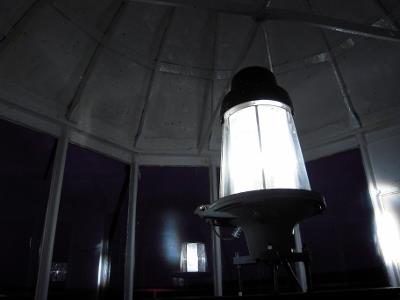
— its octagonal lantern with domed roof;
— its triangular-paned windows;
— its whitewashed exterior;
— its small, one-storey, flat-roofed entrance vestibule;
— its traditional red and white exterior colour scheme consisting of red and white for the roof, red for the gallery and railing, and white for the tower; and,
— its visual prominence in relation to the water and the landscape.
The following character-defining elements of the related buildings should be respected:
— their respective built forms, profiles, and proportions;
— their traditional red and white exterior colour schemes;
— their contextual relationships to the lighthouse within an evolved historic lightstation setting.
End of the register’s text
Location
Catalina, Newfoundland and Labrador, Canada
48.50411° N, 53.04344° W
Get directions (opens in a new tab)Being on the register doesn’t make a place open to visitors. Many are private homes or businesses; please view them from the street.

Loading map…
Nearby
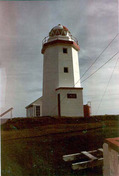 Lighttowerwithin 100 m · Green Island · 1908
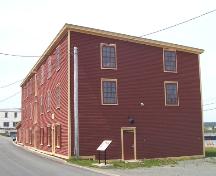 Factory/Advocate Building2.8 km · Port Union · 1920
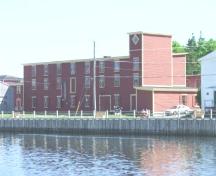 Factory/Advocate Building Municipal Heritage Building2.8 km · Port Union · 1920
 Port Union Registered Heritage District2.8 km · Port Union
 Port Union Municipal Heritage District2.8 km · Trinity Bay North · 1916
 Fishermen's Union Trading Company Retail Store Registered Heritage Structure2.9 km · Port Union · 1946
Similar places
Places whose register descriptions are closest to this one.
 Green Island LighthouseSkeena-Queen Charlotte A, British Columbia
 Cape Race LighthouseCape Race, Newfoundland And Labrador
 Belle Isle South End Lower LighthouseSt. Anthony, Newfoundland And Labrador
 Cape St. Mary's LighthouseCape St. Mary’s, Newfoundland And Labrador
 Cape Anguille LighthouseCodroy, Newfoundland And Labrador
 Île Verte LighthouseNotre-Dame-des-Sept-Douleurs, Quebec
From the Canadian Register of Historic Places, as last updated on December 12, 2025. The register’s text is shown word for word.