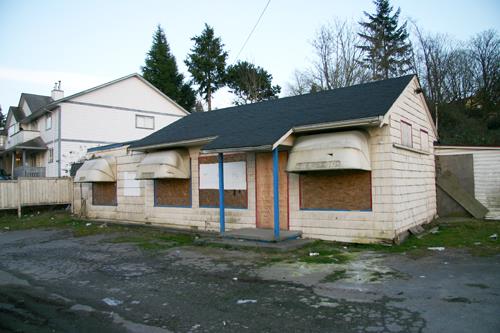
Photo: Corporation of Delta, 2008
- Reconnaissance
- 2007
- Par
- Administrations locales (C.-B.)
Le texte du répertoire, mot pour mot
Description
The St. Mungo Store is a one-storey, wood-frame side-gabled commercial building, with a front projecting shed porch. It is situated near the corner of Centre Street and River Road in North Delta.
Valeur patrimoniale
The St. Mungo Store dates from circa 1932, and is associated with commercial development along River Road in North Delta. The area developed rapidly due to booming agricultural, canning and fishing industries. Salmon fishing and processing was integral to Delta's early development. The earliest salmon canneries were built along North Delta's Strait of Georgia waterfront, and thrived as an industry that provided work for thousands of unemployed immigrants after the completion of the railway and the subsidence of gold rush activities. Drawn to these booming industries, Scandinavian immigrants settled in the area surrounding the canneries, in communities that came to be known as Annieville and Sunbury. The expansive growth of the Scandinavian community left a distinct mark on the social landscape of North Delta, including the establishment of a school in Sunbury in 1897, another in Annieville in 1906, the first Trinity Norwegian Lutheran Church at Norum Point in 1904, and a local post office in 1901. Growth of the North Delta community was hindered for a period due to the economic depression that followed the crash of 1929; however, there was slow but noticeable improvement over time, and the construction of the Pattullo Bridge between 1936-1937 increased access to the area and facilitated further development.
The St. Mungo Store demonstrates the importance of small grocery stores in defining neighbourhood character. The store was built and operated by Walter Elgin Silda (1906-1952), who was born in Rossland, BC, of Finnish descent. It reflects a way of life that was less dependent on cars and refrigeration, when people walked to local stores, usually daily, to buy fresh food and supplies. These stores thus acted as a social focus for neighbours to meet and talk. Once common, these stores are disappearing rapidly in the face of increasing competition from chain stores and shifting shopping patterns. Furthermore, the St. Mungo Store is valued as an example of the austere vernacular commercial architecture of the Depression era. It is typical of the practical, small-scale commercial buildings constructed during this period for local retail services. The St. Mungo Store is a rare surviving example in Delta of this type of establishment.
SourceCorporation of Delta Planning Department
Éléments caractéristiques
Key elements that define the heritage character of the St. Mungo Store include its:
- location near the corner of Centre Street and River Road in North Delta
- commercial form, scale and massing, as expressed by its one-storey height, front-gabled roof with front projecting shed porch and later flat roof addition to the north
- wood-frame construction including cedar shingle siding
- windows such as multi-paned wooden sash
- associated landscape features, such as mature holly trees
Fin du texte du répertoire
Emplacement
49.15821° N, 122.93853° W
Itinéraire (s’ouvre dans un nouvel onglet)L’inscription au répertoire ne rend pas un lieu accessible au public. Beaucoup sont des résidences ou des commerces privés; admirez-les depuis la rue.

Chargement de la carte…
À proximité
Les 62 lieux de Delta

Lieux semblables
Les lieux dont la description du répertoire se rapproche le plus de celle-ci.
 Dorreen Store and Railway StationDorreen, Colombie Britannique
 Bank of MontrealDelta, Colombie Britannique
- former Mount Stewart Cooperative StoreMount Stewart, Ile Du Prince Edouard
 Olaf Stokkeland ResidenceDelta, Colombie Britannique
 Stores BuildingVictoria, Colombie Britannique
 998 Gorge Road WestSaanich, Colombie Britannique
Tiré du Répertoire canadien des lieux patrimoniaux, dans sa dernière mise à jour du 12 décembre 2025. Le texte du répertoire est reproduit mot pour mot.