Endroit historique inscrit au répertoire
St. Alexis Mission
Rollo Bay East, Ile Du Prince Edouard
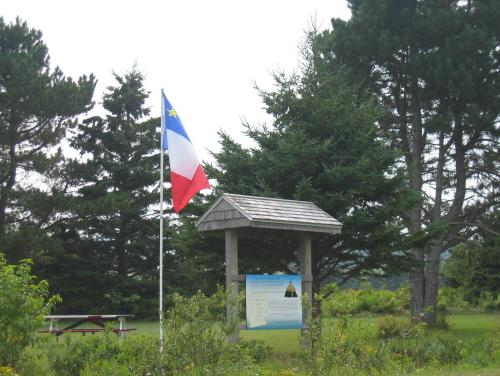
Photo: Province of PEI, 2009
- Construction
- 1804
- Reconnaissance
- 2001
- Par
- Province de l'Île-du-Prince-Édouard
Le texte du répertoire, mot pour mot
Description
The former St. Alexis Mission is located in the picturesque rural community of Rollo Bay East, PEI. It consists of remnants of an early Acadian pioneer cemetery on treed grounds overlooking the waters of Rollo Bay.
Valeur patrimoniale
The St. Alexis Mission is significant because of its association with the early Acadian settlers of eastern PEI and the traumatic period of the Acadian expulsion.
In 1755, in the aftermath of the Acadian expulsion in Nova Scotia, several families escaped and made their way to Ile St. Jean (PEI). They initially landed at Point Prim, but fear of detection by the British forced them to move further inland to Bay Fortune. They managed to survive in this area for the next forty years, even evading the 1758 deportation of the Island commanded by Lord Rollo.
By 1798, however, they were forced to move after the proprietor of the area, William Townshend, decided to settle new people (Dingwells, and others) on his lands. Some of the Acadian families then left for Cape Breton, while a small number moved further east to Rollo Bay. In the process, they left their modest church at Bay Fortune behind.
In 1804, under the direction of Father (later Bishop) Angus Bernard MacEachern, a small log church mission was established at Rollo Bay. In 1812, it was dedicated to St. Alexis, patron saint of the poor, by Bishop Joseph-Octave Plessis (1763-1825) of Quebec. He was then visiting the scattered Roman Catholic missions across the Island.
Many Acadian families still reside in the Rollo Bay area whose ancestors were part of this early mission.
The site currently contains an interpretive sign explaining the history of the site and listing the founding families of the mission. These include: Bourke, Chiasson, Daigle, Longuepee, and Pitre. The Acadian flag also flys near the highway.
There are only two remaining gravestones. One is that of Simon D'Aigle who passed away in 1849. The stone has carvings of a cross between two anchors and he is described as being the "mariner son of Simon D'Aigle." The other dates from 1858 and is that of a Scottish settler, Joseph McRae, the son of James McRae of Rollo Bay. His inscription describes him as a person "whose unassuming manners and pious demeanor rendered him deservedly esteemed and respected by all who knew him."
Source: Culture and Heritage Division, PEI Department of Communites, Cultural Affairs and Labour, Charlottetown, PE C1A 7N8
File #: 4310-20/S3
Éléments caractéristiques
The heritage value of the St. Alexis Mission is embodied in the following elements:
- the remaining headstones of the pioneer Acadian cemetery established at the time of the 1804 mission
- the interpretive sign
- the Acadian flag
- the surrounding view of Rollo Bay and the associated landscape formations
Fin du texte du répertoire
Emplacement
46.35170° N, 62.31782° W
Itinéraire (s’ouvre dans un nouvel onglet)L’inscription au répertoire ne rend pas un lieu accessible au public. Beaucoup sont des résidences ou des commerces privés; admirez-les depuis la rue.

Chargement de la carte…
À proximité

Lieux semblables
Les lieux dont la description du répertoire se rapproche le plus de celle-ci.
- Rustico Pioneer CemeteryAnglo Rustico, Ile Du Prince Edouard
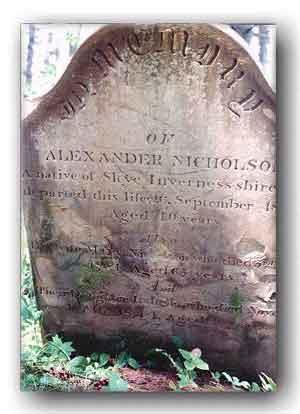 Acadian-Scottish Ancient Burial GroundEldon, Ile Du Prince Edouard
- St. Anne's Pioneer CemeteryStanley Bridge, Ile Du Prince Edouard
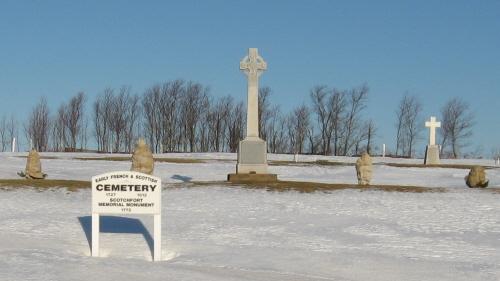 Scotchfort Pioneer CemeteryScotchfort, Ile Du Prince Edouard
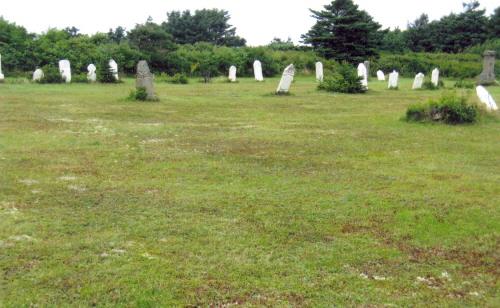 St. Margaret of Scotland Pioneer CemeterySt. Margarets, Ile Du Prince Edouard
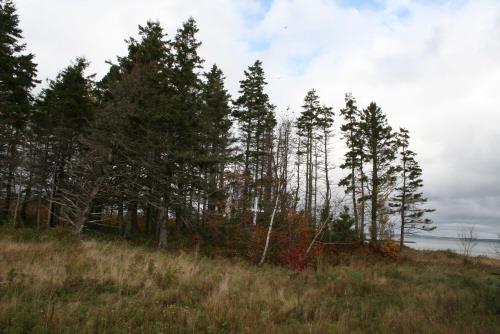 Launching 1790 Pioneer CemeteryLaunching, Ile Du Prince Edouard
Tiré du Répertoire canadien des lieux patrimoniaux, dans sa dernière mise à jour du 12 décembre 2025. Le texte du répertoire est reproduit mot pour mot.