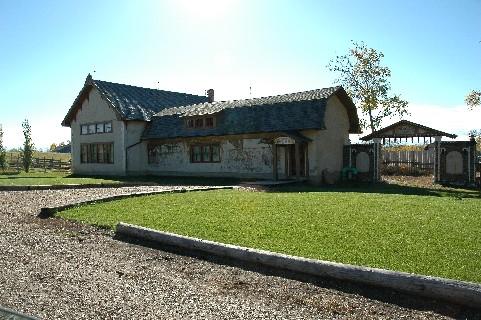
Photo: Government of Saskatchewan, Calvin Fehr, 2004
- Construction
- 1920
- Reconnaissance
- 1993
- Par
- Administrations locales (Sask.)
Le texte du répertoire, mot pour mot
Description
Imhoff Museum is a Municipal Heritage Property located eight kilometres south of St. Walburg in the Rural Municipality of Frenchman Butte. The property consists of a 3.2 hectare parcel of land that features an artist's studio, farm house, barn, and other ancillary buildings.
Valeur patrimoniale
The heritage value of Imhoff Museum resides in its association with the life and work of Berthold Imhoff, an internationally renowned artist who settled in Saskatchewan in 1914. Born in Germany where he studied painting at various academies, Imhoff immigrated to Reading, Pennsylvania in 1892 where he set up an art studio. Specializing in frescoes, murals, and biblical scenes, Imhoff established himself as a decorator of churches, opera houses, theatres, banks, movie houses, and large residences. In 1914, he relocated to northwestern Saskatchewan, where he lived and painted until his death in 1939. It was at this studio that Imhoff produced much of his artwork, including still lifes, portraits of early First Nations chiefs, European leaders and royalty, and American presidents. Well-known for his religious artwork, which he painted for little or no pay, Imhoff's work appears in over 90 churches and cathedrals throughout Canada and the United States. His dedication to the church was recognized by Pope Pius XI, who honoured Imhoff with the Knighthood of the Order of St. Gregory the Great in 1937. Upon his death in 1939, Berthold Imhoff left over 250 paintings in his studio, some of which remain there today, while others are on display in a gallery in nearby Lloydminster.
Heritage value also resides in the site's residence and purpose-built studio, both of which hold original artwork of Berthold Imhoff. Completed around 1916, the residence features Bavarian architectural detailing, as well as the artist's original frescoes on the ceilings. The studio was constructed in two stages. The first section, built in 1920, was a basic rectangular-shaped building with Bavarian overtones, evidenced in the decorative roofline and exterior frescoes and murals. A large, 1925 addition became the artist's main working area. Featuring a high ceiling with large windows on the north wall, the space provided the indirect, natural lighting preferred by artists. A unique feature of the studio is the track that runs the length of the room, upon which the artist hung the large canvases that he was painting. The studio's walls also feature some of Imhoff's original frescoes. The studio, with the farmhouse and barn, form three sides of a square, with the studio situated such that it is the first building that visitors see. Two decorative archways complement the artist's landscaped setting; one, with the inscription "Imhoff's Ville", forms a gateway to the farmstead and frames the view of the artist's studio. The second sits next to the studio and features some of Imhoff's murals. This rural setting, including the layout of the farmstead, its contributing buildings, and landscaped space, speaks to Imhoff's life as an artist and his connection to rural living. The site is a landmark in the community.
Source:
Rural Municipality of Frenchman Butte No. 501 Bylaw No. 79.
Éléments caractéristiques
The heritage value of Imhoff Museum resides in the following character-defining elements:
-those elements that speak to Imhoff's life and work as an artist, including the remaining interior and exterior murals and frescoes, ceilings, decorative archways with murals, stencil work, decorative interior paintings, furnishings, and artwork;
-those elements that reflect the site's use as an artist's studio, such as the original cabinets that hold the artist's materials used for painting, stencilling, and leafing;
-those elements that illustrate the purpose-built nature of the studio, including the high ceilings, large windows, and track system for moving large canvasses;
-those elements that speak to the layout of the farmstead, including the spatial relationahip between the farmhouse, barn, and studio on their original locations.
Fin du texte du répertoire
Emplacement
53.56873° N, 109.21288° W
Itinéraire (s’ouvre dans un nouvel onglet)L’inscription au répertoire ne rend pas un lieu accessible au public. Beaucoup sont des résidences ou des commerces privés; admirez-les depuis la rue.

Chargement de la carte…
À proximité
Les 3 lieux de Frenchman Butte RM 501

Lieux semblables
Les lieux dont la description du répertoire se rapproche le plus de celle-ci.
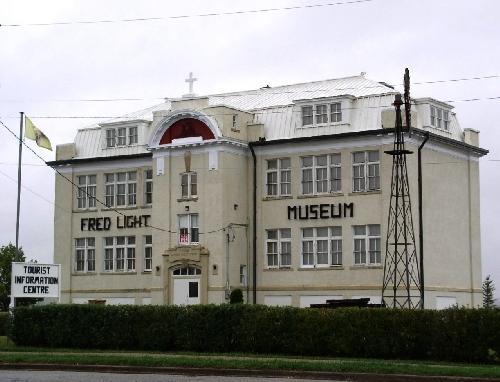 Fred Light MuseumBattleford, Saskatchewan
 Future Museum SiteRegina Beach, Saskatchewan
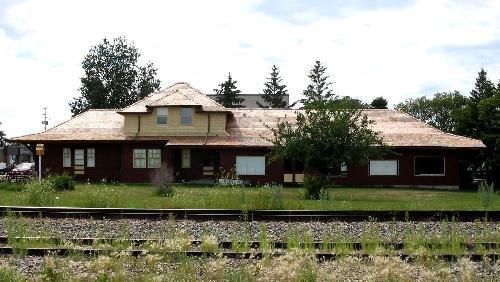 Strasbourg and District MuseumStrasbourg, Saskatchewan
 Marcel Vey Farm Yard SiteThree Lakes RM 400, Saskatchewan
 Echo Valley Conference Centre (Fort San)Fort San, Saskatchewan
 Swift Current Mennonite Heritage VillageSwift Current, Saskatchewan
Tiré du Répertoire canadien des lieux patrimoniaux, dans sa dernière mise à jour du 12 décembre 2025. Le texte du répertoire est reproduit mot pour mot.