Afton Hotel
Description
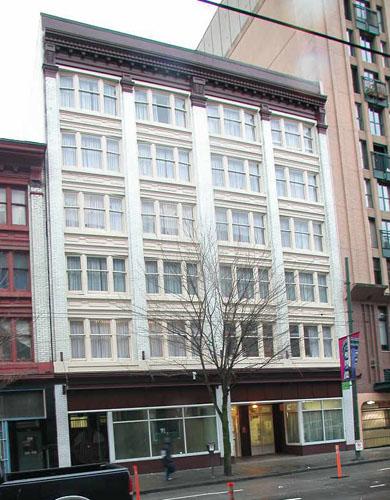
The Afton Hotel, a four-storey masonry commercial building designed in the Edwardian Italian Renaissance Revival style, is on East Hastings Street in Vancouver.
Valeur patrimoniale
The value of the Afton Hotel lies in its position in the streetscape of this block of East Hastings Street. Although the seven buildings on the north side of this block - built between 1901 and 1913 - range in height from one to eight storeys, were designed by seven different architects, and constructed of different materials, they share several features. Together they illustrate the changing use of this area of East Hastings Street from residential to business use and place the district as a shopping and commercial centre for the emerging city of Vancouver in the early twentieth century. The architectural styles speak to the changing public taste from the ornate decoration of the late Victorian era to the more refined ornamentation of the Edwardian age.
Built in 1912 to a design by architect Arthur Julius Bird for owner R. B. Hamilton, the structure was designed as an apartment building. The symmetry and masonry construction exemplify the Edwardian styling, although the curved pediments at the top of two rows of windows are an unusual feature. It was altered in 1914 when it housed Burlington Tailors on the main floor with government offices, including Vancouver postal substation B on the street level, and a variety of Canadian government offices located on the upper floors. Since 1925, the upper floors have been used as a rooming house, and more recently as the Afton Hotel.
After 1917, the postal substation relocated and the ground floor was utilized by a series of retail outlets, tailor shops, and restaurants, including the Ovaltine Café in 1942. The exuberant Ovaltine Café neon signage with its distinctive arrow-shaped projecting sign, made by Wallace Neon in 1942, evokes the 1940s and 1950s, Vancouver’s 'golden age' of neon, when there was reportedly more neon in Vancouver than anywhere in the world, except for Shanghai, China. The interior of the café has survived intact, and includes a coffee counter, booths, mirrors and varnished woodwork.
Source: City of Vancouver Heritage Conservation Program
Éléments caractéristiques
The character-defining elements of the historic place include:
- commercial form, four-storey scale and rectangular massing
- built right to the lot line with no setbacks
- its physical and stylistic relationship with other buildings within the East Hastings Street strip and adjoining neighbourhoods
- its location in a grouping of hotels and lodgings on East Hastings Street
- its early use for Canadian government offices
- characteristics of the Edwardian Italian Renaissance Revival style including: rusticated stone string courses above ground floor level, three dimensional lead lights above storefront, sheet metal upper cornice with bracket and medallions, metal cornice above storefront, unusual pediments at top of two rows of windows
- significant interior features of the Ovaltine Cafe interior, including coffee counter, booths, mirrors and varnished woodwork
- Ovaltine Cafe projecting and storefront neon signs
Location
Loading map...
Lieux similaires
Sites patrimoniaux avec des caractéristiques semblables