National Historic Site of Canada
Fort Livingstone National Historic Site of Canada
Pelly, Saskatchewan
Also known as Fort Livingstone, Swan River Barracks, Caserne de la rivière Swan
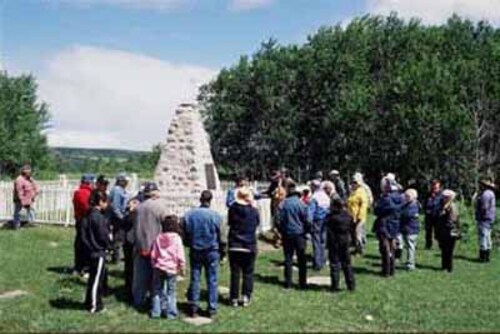
View of Fort Livingstone, showing its setting high on a hill surrounded by woods, 2005.
Photo: Agence Parcs Canada / Parks Canada Agency.
- Built
- 1874–1875
- Recognized
- 1923
- By
- Government of Canada
The register’s text, word for word
Description
Fort Livingstone National Historic Site of Canada is an archaeological site that once housed the first North West Mounted Police barracks in the west. Located on an upland peninsula above the east bank of Snake Creek near its junction with the Swan River, it is approximately 16 kilometres north of the town of Pelly, Saskatchewan. The designation refers to the site and its archaeological remains.
Heritage value
Fort Livingstone was designated a National Historic Site of Canada because:
- it was the first capital of the Northwest Territories, 1876-1877;
- it was the original headquarters and first post built specifically for the North-West Mounted Police.
The heritage value of Fort Livingstone lies in its historical associations with the Government of Canada and the North-West Mounted Police (NWMP) as illustrated by the setting of the fort and the remnants it contains describing life during NWMP occupation. Fort Livingstone was built in 1874-75 by the Department of Public Works, and was originally known as Swan River Barracks. In 1884, shortly after the territorial capital was removed in 1876, the fort was destroyed by prairie fire. The fort once housed 185 men and contained sufficient buildings to accommodate them in a remote location. The fort included Married Men’s Quarters, Men’s Quarters, Officers’ Quarters, a hospital and three unidentified buildings or structures of which remnants remain.
SourceHistoric Sites and Monuments Board of Canada, Minutes, June 1973; Commemorative Integrity Statement.
Character‑defining elements
Key elements contributing to the heritage value of this site include:
- the setting of the fort, high on a granite hill beside Snake Creek surrounded by woods;
- viewscapes to the Swan River and its northernmost crossing point, to historic trails, along the Snake Creek and Swan River valleys;
- the natural vegetation of the area, particularly its grass, and groves of aspen and hawthorn;
- the evidence of the early telegraph passages;
- the footprint and profile of remnants of the fort and its outbuildings, largely the foundation and cellar remains;
- the evidence of the construction, materials, functional use and siting of the buildings;
- the evidence, mostly below ground, of life at the post, including those artefacts excavated from the site and stored by Parks Canada and the Pelly Museum.
End of the register’s text
Location
Highway 661, Pelly, Saskatchewan, Canada
51.90249° N, 101.95814° W
Get directions (opens in a new tab)Being on the register doesn’t make a place open to visitors. Many are private homes or businesses; please view them from the street.

Loading map…
Nearby
All 4 places in Pelly
Similar places
Places whose register descriptions are closest to this one.
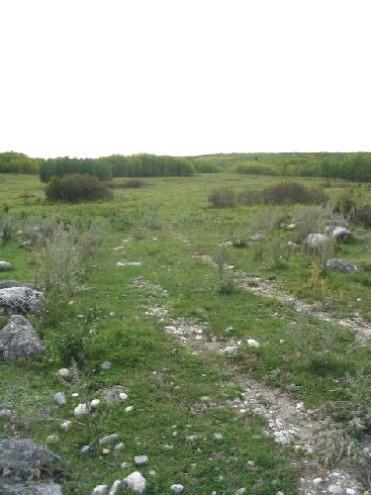 Fort Livingstone Protected AreaLivingston RM 331, Saskatchewan
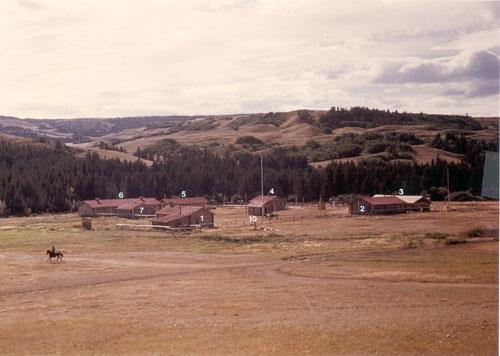 Fort Walsh National Historic Site of CanadaMerryflat, Saskatchewan
 South Branch House Provincial Historic SiteSt. Louis RM 431, Saskatchewan
 Fort Battleford National Historic Site of CanadaBattleford, Saskatchewan
 Fort Pitt Provincial ParkFrenchman Butte RM 501, Saskatchewan
 Fort Espérance National Historic Site of CanadaRocanville, Saskatchewan
From the Canadian Register of Historic Places, as last updated on December 12, 2025. The register’s text is shown word for word.