FIRST PRESBYTERIAN CHURCH
Description
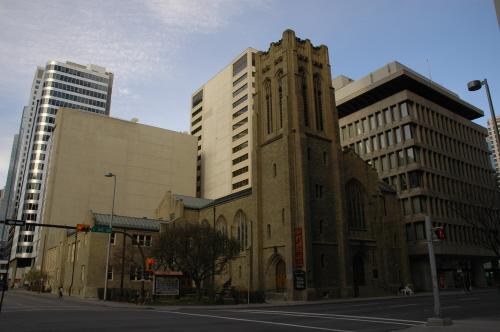
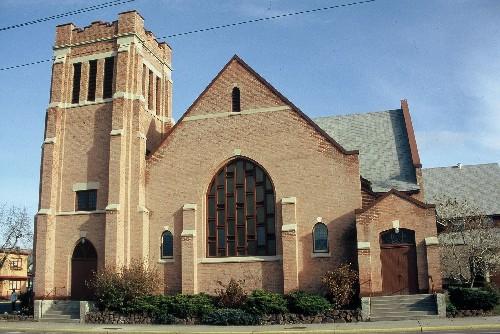
First Presbyterian Church is a large, Late Gothic Revival style building, constructed of red brick and sandstone, and located on six city lots in the heart of downtown Edmonton. A hall is attached to the east side of the building. The church is surrounded by urban development including a neighbouring high-rise tower, and stands as a prominent city landmark.
Heritage Value
The heritage value of First Presbyterian Church lies in its Gothic Revival style architecture and its association with Reverend D.G. McQueen, an important clergyman in the history of the Presbyterian Church in Alberta.
A model Late Gothic Revival church, First Presbyterian Church has stood, since its construction in 1911, as a landmark church in downtown Edmonton. While not the earliest Presbyterian church built in Edmonton, First Presbyterian Church was certainly the largest, built to seat over twelve hundred people. Significantly, the plan represents an adaptation of the popular Gothic Revival "Akron Plan" of church architecture. By incorporating large Gothic windows, the architectural firm of Wilson and Herrald were able, despite the size of the building, to create a space that was monumental, but not overwhelming. Grand in scale and finely crafted inside and out, the building retains its landmark status as a unique church building amidst the urban environment surrounding it.
Reverend David George McQueen was First Presbyterian Church's second - and most significant - minister. His ministerial tenure of forty-three years, one of the longest recorded in Alberta, helped to establish the Presbyterian presence in Alberta. McQueen came to Edmonton shortly after graduating from Knox College, Toronto. He followed Reverend James Robertson's call to the West, arriving in Edmonton in the summer of 1887. He considered work in a foreign mission field, like his classmate Jonathan Goforth, but as the story goes, Robertson put his hand on the young student's shoulder and said, "I want you for Edmonton," a calling too powerful to ignore. Once in Edmonton, he served briefly with Dr. Andrew Baird, who began the work of organizing congregations in the area in 1881. He quickly built upon this foundation and throughout Edmonton and the surrounding area new congregations were formed under his guidance. During McQueen's service as minister of First Presbyterian Church, he helped build, strengthen and maintain a Presbyterian presence in the West. He was elected as Moderator of the General Assembly in 1912 and as Interim Moderator of the General Assembly of the continuing Presbyterian Church in 1925 during the turbulent time of church union. McQueen passed away in 1930.
Source: Alberta Culture and Community Spirit, Historic Resources Management Branch (File: Des. 494).
Character-Defining Elements
The character-defining elements of First Presbyterian Church include such features as:
Site:
- location in the heart of Edmonton.
Exterior:
- size, form, scale, and massing;
- rusticated sandstone base;
- main facade featuring square corner bell tower with crenellated parapet, buttresses, triple arched open porch entrance, spandrels surrounding the main entrance;
- pressed brick and sandstone exterior elements such as the cornerstone, stringcourses, and receding Gothic arches;
- irregular fenestration pattern;
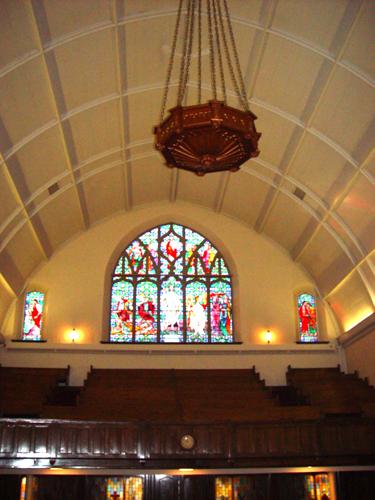
- large gothic windows with stone tracery and leaded stained glass;
- hall set perpendicular to the church proper;
- slightly rounded, shallow and gently ranked treatment of the buttresses.
Interior:
- gently sloping floor with an amphitheatre-like arrangement of pews and balcony that radiates around the central pulpit;
- two-tier classroom spaces set in a semi-circular plan;
- irregular arrangement of ancillary rooms throughout the structure;
- wood strip ceiling complete with exposed wood truss system;
- wood staircases, wainscots, trim, flooring, and decorative elements;
- Casavant pipe organ set in a semi-dome complete with plaster ornamentation and recessed arches springing from cluster columns.
Gallery
1 imageLocation
Loading map...
Similar Places
Heritage sites with similar characteristics