Debert Palaeo-Indian Site
Description
The Debert site, located in central Nova Scotia, is the oldest archaeological site in the province and is recognized as one of the most important prehistoric sites in the province. The artifacts found here date from 10,600 to 13,000 years ago. The site has been designated a Special Place by the Nova Scotia provincial government.
Heritage Value
Debert is valued for its evidence of and association with Nova Scotia’s first peoples. The archaeological evidence found here reveals several living areas and a large number of stone artifacts. The site is the most northeasterly known Palaeo–Indian occupation and is one of only a few Palaeo-Indian sites discovered in a glaciated area. The last of the glacial ice retreated approximately 12,000 years ago. These first people managed to live successfully in a cold and rapidly changing environment.
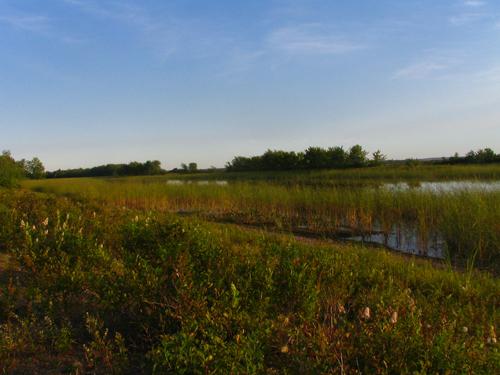
More than 5000 stone artifacts have been found at Debert, many of which would have been used for hunting and preparing hides. The site is situated in an area that has an excellent view of the Cobequid Basin, giving the occupants an ideal view to be able to intercept herds of migrating animals. The location, along with the surviving stone artifacts suggests that people were there to hunt; the site may have only been used seasonally but over many generations. The artifacts consist of fluted points, knives, scrapers and gravers. Fluted points were made by removing small flakes from the rock to create a concave space at the bottom of the point, which would then most likely be attached to a spear.
The first of the Palaeo-Indian artifacts were found on the grounds of the former RCAF Station Debert, military camp, in 1948. It was not until 1955 that the significance of the site was recognized. The first archaeological testing began in 1962, and a major excavation took place in 1963 and 1964 by the Peabody Foundation for Archaeology, the National Museums of Canada, and the Nova Scotia Museum; research has continued through the decades at Debert.
Sources: Debert Palaeo-Indian Site, Protected Site Case Files and Heritage Site Inventory Case Files, Special Places Program, Heritage Division, Department of Tourism, Culture and Heritage.
Character-Defining Elements
Character defining elements of the Debert Palaeo-Indian site include:
-view plane of the Cobequid Basin;
-Palaeo-Indian stone artifacts including fluted points, knives, scrapers, and gravers remaining in situ.
Gallery
3 imagesSimilar Places
Heritage sites with similar characteristics