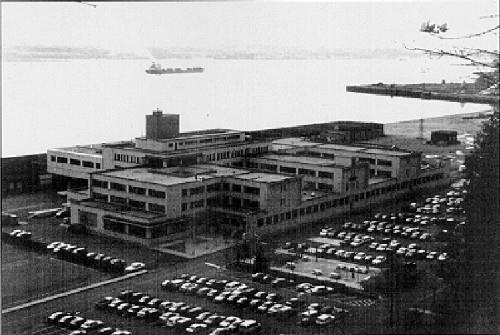
View of the Champlain Maritime Station, showing its large scale, modern design and prominent location, 1998.
Photo: Patri-Arch, 1998.
- Built
- 1959
- Recognized
- 1999
- By
- Government of Canada
The register’s text, word for word
Description
The Champlain Maritime Station is located in the l’Anse-au-Foulon of Québec’s port area. A sprawling, modern building, it is notable for its white reinforced concrete exterior, its varying volumes and long, banded windows. The designation is confined to the footprint of the building.
Heritage value
The Champlain Maritime Station is a Recognized Federal Heritage Building because of its historical associations, and architectural and environmental values.
Historical Value
The Champlain Maritime Station illustrates the important role of Québec as a point of entry for millions of immigrants into Canada during the mid 20th century. The building’s construction, which followed the creation of the Department of Citizenship and Immigration in 1950, reflects a period of changing immigration policies, which provoked a significant increase of immigrants into the country, necessitating the construction of new processing facilities. Locally, the construction of the Champlain Maritime Station at l’Anse-au-Foulon was key to the westward expansion of the port and as such, justified further investment in that part of the city.
Architectural Value
The Champlain Maritime Station is valued for its very good, formal aesthetic example of the International style. The building is composed of aerodynamic and complex volumes, reinforced concrete, and little ornamentation, which is evocative of an aesthetic based on engineering concepts. The building demonstrates a very good functional design where the administrative functions necessary to processing new immigrants are conveniently located under one roof. Carefully planned circulation patterns add to this very functional building.
Environmental Value
The Champlain Maritime Station, along with “Hangar A” (the first administration building built in 1931) and the railway, together are compatible with and contribute to the port setting of l’Anse-au-Foulon. The building is familiar in the area.
SourcePatri-Arch patrimoine et architecture, Gare maritime Champlain, Quebec, Quebec, Federal Heritage Buildings Review Office, Building Report, 98-054; Gare maritime Champlain Building, Quebec Québec, Heritage Character Statement, 98-054.
Character‑defining elements
The character-defining elements of the Champlain Maritime Station should be respected.
Its very good aesthetic design in the International style, its very good functional design and good craftsmanship and materials, for example:
- the massing and volume that together form an assembly of boxes placed one upon the other (certain on pilotis), with storeys of varying heights (ranging between one and four floors);
- the flat roof without cornices;
- the horizontal emphasis as seen in the long, banded fenestrations;
- the smooth exterior finish of the poured-in-place concrete complemented by infrequently placed striated concrete panels;
- the clean lines of the building’s canopies;
- the use of modern materials such as aluminium, stainless steel, marble, travertine, terrazzo and linoleum;
- the highly functional design of the interior spaces inclusive of the circulation patterns, typical of such buildings built in the mid-20th century.
The manner in which the Champlain Maritime Station is compatible with its port setting and is a familiar building, as evidenced by:
- its overall scale, design and materials, which harmonize with the architectural fabric of the port area;
- its large scale, modern design and prominent location which make it a familiar building in l’Anse-au-Foulon area of Québec.
End of the register’s text
Location
901, rue du Cap-Diamant, Québec, Quebec, Canada
46.79620° N, 71.22100° W
Get directions (opens in a new tab)Being on the register doesn’t make a place open to visitors. Many are private homes or businesses; please view them from the street.

Loading map…
Nearby
All 194 places in Québec

Similar places
Places whose register descriptions are closest to this one.
From the Canadian Register of Historic Places, as last updated on December 12, 2025. The register’s text is shown word for word.