Recognized Federal Heritage Building
Building 38
Montmagny, Quebec
Also known as Medical Assistant's House, Maison de l'assistant médecin
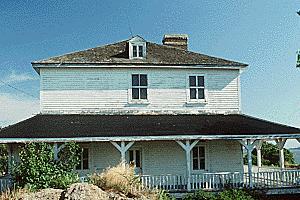
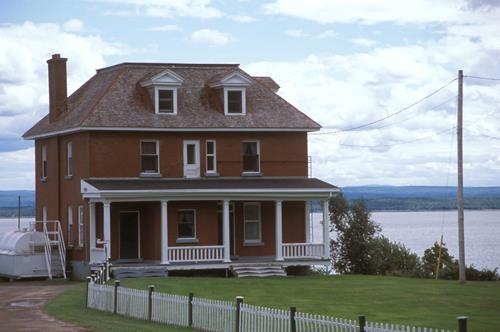
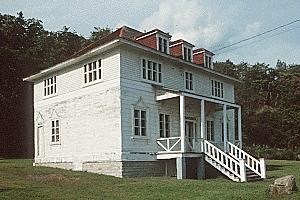
Side view of Building 38, showing the exterior walls clad in clapboard and wooden shingles and the large covered verandah, circa 2004.
Photo: Parks Canada Agency / Agence Parcs Canada, circa / vers 2004.
- Built
- 1893
- Recognized
- 1991
- By
- Government of Canada
The register’s text, word for word
Description
Building 38, also known as the Medical Assistant’s House, is situated on a small rise near the central sector at Grosse-Île, in the Grosse Île and the Irish Memorial National Historic Site of Canada. The large two-storey wooden building has an “L”-shaped plan, and hipped roofs that are pierced by two large chimney stacks and a single dormer. A large covered verandah occupies three sides of the building. The designation is confined to the footprint of the building.
Heritage value
Building 38 is a Recognized Federal Heritage Building because of its historical associations, and its architectural and environmental values:
Historical value
Building 38 is associated with Canadian immigration and quarantine. Situated on the St Lawrence River 50 km from the Port of Québec, which it served, Grosse Île functioned as the most important quarantine station for immigrants arriving into Canada between 1832 and 1937. Immigrants were disembarked and passed health examinations at the station. In 1857, with the end of British control, the Canadian government became responsible for the Grosse Île quarantine station.
Architectural value
Building 38 is valued for its good aesthetic design. The building derives from a model inspired by the late 19th-century cubic houses and features an asymmetrical composition. The modest exterior encloses a functional, dual occupancy design, family home and servant’s quarters that includes a concealed staircase. Very good craftsmanship and materials are evidenced in the interior layout and elegant decor that includes built in furniture, such as the noteworthy fireplaces.
Environmental value
Building 38 reinforces the present historic character of its Grosse Île setting. The structure is a well-known local landmark to the local community and to visitors.
SourceThe Medical Assistant’s House (no.38), Grosse Île (Part 3 1881-1910), Quebec, Federal Heritage Buildings Review Office, Report 90-031; The Medical Assistant’s House (No.38), Grosse Île, Quebec, Heritage Character Statement 90-031.
Character‑defining elements
The character-defining elements of Building 38 should be respected.
Its good aesthetics, functional design and very good craftsmanship, for example:
- the large, two-storey massing on an “L”-shaped plan with hipped roofs with dormer and two large chimney stacks;
- the timber construction;
- the regular placement of the doors and the four pane windows;
- the exterior walls clad in clapboard and wooden shingles and the large covered verandah (that occupies three sides of the building) and which becomes a glassed portico on the north side;
- the extension on the side of the building containing the kitchen downstairs, and the domestic’s quarters upstairs;
- the interior configuration and finishes, including the fireplaces, the concealed staircase, the wooden floors, the lath and plaster walls and ceilings, the built-in wood furniture and the cast-iron radiators.
The manner in which Building 38 reinforces the historic character of Grosse Ile, and is a landmark on the St. Lawrence River, as evidenced by:
- its imposing scale, its design and materials, which complement the related adjacent structures including the Vaccination and Medical Examination Office and the Guard Post;
- its high visibility and familiarity within the local area, due to its location on a small rise at the entrance to the central sector on Grosse-Île.
End of the register’s text
Location
Montmagny, Quebec, Canada
47.02800° N, 70.66800° W
Get directions (opens in a new tab)Being on the register doesn’t make a place open to visitors. Many are private homes or businesses; please view them from the street.

Loading map…
Similar places
Places whose register descriptions are closest to this one.
From the Canadian Register of Historic Places, as last updated on December 12, 2025. The register’s text is shown word for word.