Bank of Nova Scotia
Description
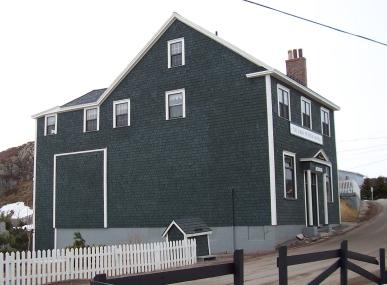
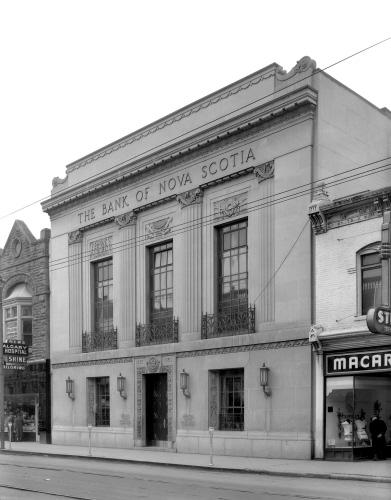
Built circa 1913, the Bank of Nova Scotia is a tall, brick, single-storey Georgian Revival bank building with a central entry flanked by Roman arch windows and topped by a well-defined pediment. It is located in the heart of downtown St. Andrews at the intersection of King Street and Water Street.
Heritage Value
The Bank of Nova Scotia is designated a Local Historic Place for its architecture and for its nearly 100 year association with the Bank of Nova Scotia.
The Bank of Nova Scotia is an excellent example of the Georgian Revival style, a popular commercial style in North American architecture in the early 20th century. This style is evident in such characteristics as the flat roof and an elevated entrance with classical details such as Roman arch windows and entranceway details. The large Roman arch windows flank the handsome entranceway with perfect symmetry. The entranceway is crowned by a heavy pediment supported by fluted pilasters. The use of Greek and Roman elements was considered appropriate for public buildings, especially banks, as they suggested power, permanence, and tradition.
This building is one of the first banks designed by John Lyle, an important architect in Canadian history. He was a pioneer in bringing a sense of national decorative elements to the forefront in Canada and helped bring about early Modernism to the country. Lyle studied at the École des Beaux-Arts in Paris.
This building was constructed for the Bank of Nova Scotia, which originated at Halifax, Nova Scotia, in 1832. By the early 1900’s, a coast-to-coast Canadian branch network had been established. Expansion accelerated through an amalgamation with four banks, including the Bank of New Brunswick, between 1882 and 1919. The Bank of Nova Scotia (Scotiabank) continues to occupy the building.
Source: Charlotte County Archives, Old Gaol, St. Andrews, NB.
Character-Defining Elements
The character-defining elements of the Bank of Nova Scotia include:
- monumental single-storey rectangular massing;
- flat roof;
- cornice with “Bank of Nova Scotia” in frieze band;
- brick construction;
- concrete foundation;
- symmetrical façades;
- large Roman arch windows with keystones;
- central entranceway crowned by pediment and flanked by fluted pilasters;
- prominent corner property;
- raised entry.
Gallery
3 imagesLocation
Loading map...
Similar Places
Heritage sites with similar characteristics